
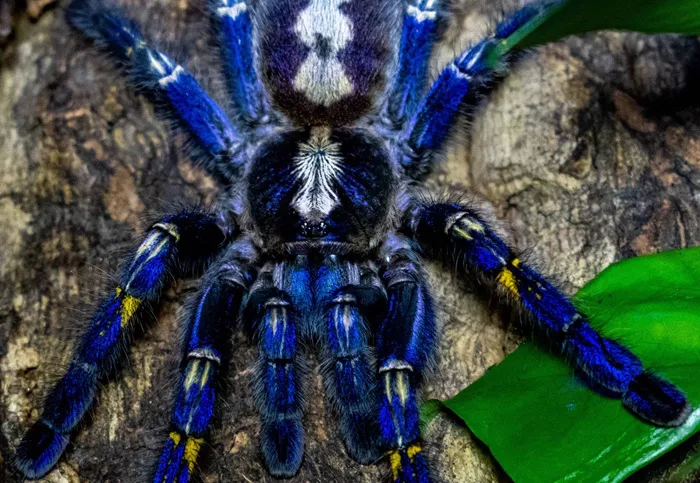
Ever heard of a tarantula that’s not only dangerous but also an absolute stunner in appearance? Well, meet the Gooty Sapphire Tarantula, scientifically known as Poecilotheria metallica. With its vibrant blue hues and stunning web patterns, this spider is a living gem of nature. But don’t let its beauty fool you—this creature comes with a unique set of challenges and fascinating behaviors that make it a rare gem in the world of tarantula enthusiasts.
In this article, we will uncover everything you need to know about the Gooty Sapphire Tarantula—from its remarkable appearance to its behavior, venom, and conservation status. Ready to dive in? Let’s explore!
What Makes the Gooty Sapphire Tarantula Unique?
At first glance, it’s impossible to miss the Gooty Sapphire Tarantula’s incredible appearance. Imagine a spider dressed in a royal blue suit, with an intricate, almost fractal-like pattern covering its body. This tarantula is one of the few spiders in the world that is actually blue, making it a true marvel in the arachnid world.
But the Gooty Sapphire isn’t just pretty—it’s also a creature of mystery. It’s a spider that lives in the forests of southern India, a species that has been around for millions of years but is now critically endangered. What’s behind this? Let’s break it down.
The Discovery of Poecilotheria metallica
The first specimen of this beautiful spider was sent to the British Museum in 1898 by H.R.P. Carter, who received it from an engineer working for the Madras Railway. This spider, found near the town of Gooty in India, was initially misidentified, but after some careful study by British zoologist Reginald Innes Pocock, it was named Poecilotheria metallica.
Why “metallica”? Well, “metallic” refers to the spider’s shiny, blue color. This wasn’t just a cool name—Poecilotheria metallica became the only known blue species in its genus. And, like the Metallica band (maybe a coincidence, but still fun to think about!), this tarantula became a heavy hitter in the arachnid world.
Anatomy and Appearance: Nature’s Blue Wonder
What truly sets the Gooty Sapphire Tarantula apart is its mesmerizing blue color. This spider is the only one in its genus to have blue hair, a trait that makes it quite rare and sought after by collectors.
Young vs. Adult Appearance
When young, the spider’s blue color isn’t as vibrant. But as it matures, it transforms into a stunning sapphire blue, giving it a majestic look. The adult female Poecilotheria metallica reaches a leg span of about 6–8 inches (15–20 cm), making it one of the larger species of tarantulas.
Interestingly, the males have a more slender body and longer legs, and their blue color is less intense. In fact, mature males have a significant feature that helps experts distinguish them—embolus (special organs at the end of their pedipalps).
Where Do Gooty Sapphire Tarantulas Live?
In the wild, the Gooty Sapphire Tarantula is found in a very small, specific range in southern India. Its natural habitat is the deciduous forests in Andhra Pradesh, with an area less than 100 square kilometers. This is why the Gooty Sapphire is classified as Critically Endangered by the International Union for Conservation of Nature (IUCN).
Despite its beautiful, rare appearance, the Gooty Sapphire Tarantula is slowly losing its home. Logging, firewood harvesting, and the pet trade are all contributing factors to its declining population.
Behavior and Diet: A Skittish but Predatory Creature
Arboreal and Fast
Gooty Sapphire Tarantulas are primarily arboreal, meaning they live in trees. These spiders make funnel-shaped webs at the base of tree trunks or in tree hollows. While they are often skittish and prefer to escape rather than fight, they are still fast and dangerous when provoked.
Like most spiders, the Gooty Sapphire feeds on insects—mostly flying insects, which it captures in its webs. Tarantulas aren’t picky, and they may also snack on moths, grasshoppers, and cockroaches.
One of the most interesting things about this species is its communal behavior. When space in the trees is limited, Gooty Sapphire Tarantulas may share their living spaces. But don’t think they’re always friendly—territorial disputes can still arise!
Longevity and Lifespan
In captivity, female Gooty Sapphire Tarantulas can live between 11 to 12 years, while the males typically live only about 3 to 4 years. This is common in the world of tarantulas, where males usually have shorter life spans compared to females.
Venom: Not for the Faint of Heart
While this tarantula is beautiful, it’s not exactly a cuddly pet. The bite of Poecilotheria metallica can be medically significant, causing intense pain, swelling, and discomfort. The venom can also cause increased heart rate, headaches, cramping, and sweating. Thankfully, there has been no recorded human death from a Gooty Sapphire’s bite.
But if you’re a pet owner, you must be cautious when handling them. Dry bites, where no venom is injected, are common, but even a bite without venom can still be painful due to the size of their fangs. Safety first!
Coloration and Evolution: Why the Blue?
The blue coloration of the Gooty Sapphire Tarantula is not just for looks—it’s a fascinating example of how nature works. Scientists believe that the tarantula’s blue color could be related to mate selection or possibly even contests between males for mates.
The color comes from tiny, almost microscopic structures in its hair that reflect light in a way that produces that stunning blue hue. This kind of structural color is something you might see in other animals, like butterflies or even peacocks. Isn’t that incredible?
Conservation: Why Should We Care?
The critically endangered status of the Gooty Sapphire Tarantula should be a wake-up call. This species is at risk of extinction due to habitat loss, logging, and the pet trade. It’s vital that we protect their natural habitat and ensure that we don’t lose this living gem forever.
Interestingly, captive breeding has been successful in recent years, and there’s hope that these tarantulas can be protected in captivity. However, conservationists urge that the wild populations need more attention if they’re to survive.
Conclusion
The Gooty Sapphire Tarantula is truly a marvel of the arachnid world. With its stunning blue color, fascinating behavior, and unique place in nature, it’s one of the most beautiful—and rare—tarantulas you can find. But its future is uncertain, and it’s up to all of us to protect this incredible creature.
Whether you’re a pet enthusiast, a nature lover, or someone simply interested in the wonders of the animal kingdom, the Gooty Sapphire Tarantula is definitely worth learning about. Don’t miss out on the chance to explore one of nature’s hidden treasures!
Related topics: