
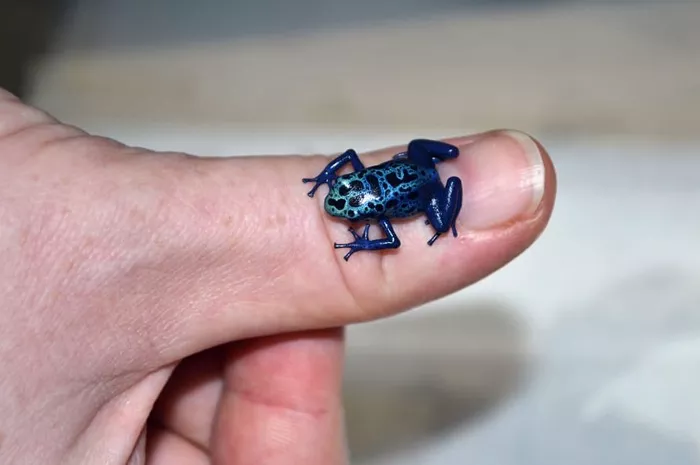
When you think about frogs, what comes to mind? Most likely, a little green or brown amphibian hopping around on a pond or by a river. But there’s a specific type of frog—the blue poison dart frog—that stands out not just for its striking color but for its surprising toxicity. You may have heard about these frogs and wondered: What happens if you touch one?
It’s a burning question for anyone fascinated by reptiles or amphibians. After all, a creature so colorful and attractive might be irresistible to touch. But, as you’ll soon learn, there’s much more to these frogs than meets the eye.
A Stunning Color, But a Silent Threat
Blue poison dart frogs, scientifically known as Dendrobatoides tinctorius, are part of the Dendrobatidae family. Their bright, almost neon blue skin is one of the most striking traits about them. While they may look like something out of a fantasy world, these frogs carry one of nature’s most potent defenses: toxins.
Now, imagine walking through a tropical rainforest in Central or South America, where these frogs are native. You’re on a wildlife expedition, admiring the beauty around you, and then you spot one of these little guys perched on a tree branch or leaf. Its electric-blue skin catches your attention immediately. You might think, “It’s so beautiful! I want to touch it.” But that would be a mistake.
What Happens If You Touch a Blue Poison Dart Frog?
Let’s break down what could happen if you do decide to touch one of these frogs. First, don’t panic. The experience might not be as dramatic as you might fear, but it can still be harmful.
1. The Toxin: What Makes Their Skin Dangerous?
Blue poison dart frogs are not venomous in the traditional sense. This means they don’t inject toxins like a snake or scorpion. Instead, they secrete toxic compounds through their skin, known as batrachotoxins. This is the same type of poison found in some of the world’s most dangerous species, like the golden poison dart frog.
When you touch a blue poison dart frog, these toxins can transfer to your skin. But the real danger comes when you touch your face or eyes afterward. Imagine you’ve just handled a frog, and without thinking, you rub your eyes. That’s when you might start feeling the effects. The toxin can cause a range of symptoms, from mild irritation to more severe reactions.
See Also: How Do Blue Poison Dart Frogs Get Their Color?
2. What Are the Effects on Humans?
For most people, touching a blue poison dart frog may cause slight discomfort, such as:
Mild skin irritation: A tingling or itching feeling on the part of your skin that touched the frog.
Swelling or redness: This might appear on the contact area.
Nausea or dizziness: If the toxin is absorbed in significant amounts or rubbed into sensitive areas like your eyes, it can lead to feeling lightheaded or sick.
In extreme cases, if someone has sensitive skin or allergic reactions, the toxin can be more potent. However, it’s important to note that blue poison dart frogs in captivity are less toxic. In the wild, their diet, which consists of ants, termites, and other small insects, contributes to the development of their poison. In captivity, they don’t have access to these same food sources, so their toxicity is much lower.
3. Can It Be Fatal?
While it’s unlikely for humans to die from touching a blue poison dart frog, the toxins can be fatal to smaller animals. That’s why these frogs are so effective at deterring predators. In the wild, only animals with natural immunity, such as certain reptiles or other amphibians, can safely interact with them.
For humans, the primary concern is the risk of toxicity exposure through mucus membranes, such as the eyes, mouth, or nose. If you were to accidentally ingest or inhale the toxins in a large amount, it could cause more severe symptoms like heart problems, but fatalities are rare. Still, it’s wise to exercise caution when encountering these vibrant creatures.
4. The Frog’s Defense Mechanism: Why Are They So Toxic?
The toxicity of blue poison dart frogs is an evolutionary adaptation to protect them from predators. You see, in the wild, many animals, including birds and mammals, would love to feast on these frogs. But the potent toxins serve as a powerful deterrent.
Imagine you’re a bird or reptile and you’ve just spotted a meal—a tiny frog with colorful skin that seems easy to catch. But the moment you take a bite, your body goes into overdrive, reacting to the chemicals in the frog’s skin. That’s how these frogs avoid being eaten, and it’s why they’ve evolved such a powerful defense mechanism.
Interestingly, the frogs are non-toxic when raised in captivity because they don’t consume the diet that produces their toxins. However, they can still secrete a small amount of poison due to genetic factors.
5. Should You Be Afraid of Touching One?
At the end of the day, blue poison dart frogs aren’t out to get you—they’re just trying to protect themselves. But if you’re ever in the wild and spot one, it’s best to admire it from a distance. These creatures are truly one of nature’s wonders, with their dazzling blue skin and amazing adaptations. But they’re also a reminder that, sometimes, beauty comes with a bit of danger.
If you’ve been lucky enough to spot one, take a step back, enjoy the view, and keep your hands to yourself. It’s much safer (and far more respectful to the frog) to leave them in peace.
Conclusion
So, what happens when you touch a blue poison dart frog? It’s not something you want to find out the hard way. While the effects might not be deadly, it’s still dangerous and unpleasant. These frogs are fascinating creatures, but they remind us of the delicate balance between beauty and danger in nature. If you ever find yourself near one of these incredible amphibians, take a moment to appreciate their stunning colors from a safe distance, and remember that some creatures are best left untouched.
Related topics: