
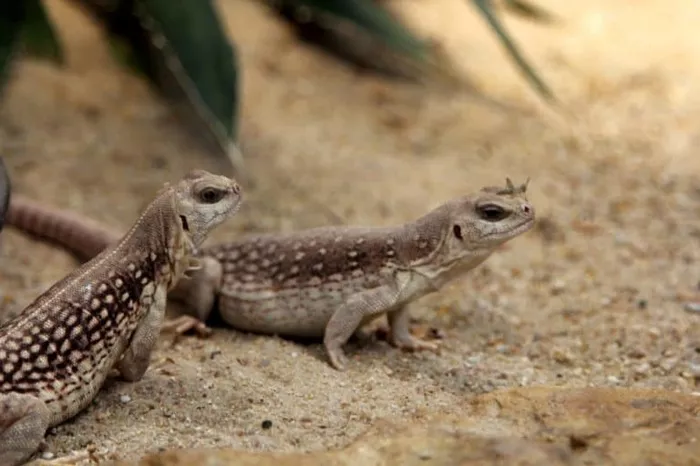
When most people think of desert animals, they picture solitary creatures battling harsh conditions to survive. But when it comes to the desert iguana (Dipsosaurus dorsalis), things might not be quite so simple. Are these lizards more than just survivors of the scorching heat and dry sands of the Sonoran and Mojave deserts? Do desert iguanas display social behaviors that might surprise you? Let’s dive into the fascinating world of desert iguanas to find out.
Understanding the Desert Iguana: A Quick Introduction
Before we get into the question of their social lives, let’s get familiar with the desert iguana. These medium-sized lizards are found primarily in the southwestern United States and parts of Mexico, thriving in environments like the Sonoran Desert and Mojave Desert. They are specially adapted to handle extreme temperatures, and you’ll often find them basking in the desert heat, sometimes being the only reptiles active during the hottest parts of the day.
But while their ability to endure high temperatures is impressive, desert iguanas are often misunderstood in terms of their social behavior. You might think that all desert animals are loners, much like how the cactus stands alone in the vast desert. However, desert iguanas show a variety of behaviors that suggest they may be more social than you’d expect.
Social Behavior in Desert Iguanas: An Overview
When we talk about “social” in animals, it doesn’t necessarily mean that they live in groups like wolves or elephants. In fact, desert iguanas are not group animals, but that doesn’t mean they’re solitary all the time. Their social interactions are primarily tied to territory, mating, and sometimes shared spaces, like hiding spots.
Territoriality: The Key to Understanding Their Social Life
Desert iguanas are known to be territorial, especially the males. Picture a game of “king of the hill” — that’s how males often behave when they stake their claim over a particular area. The males will establish territories around food sources, like creosote bushes, or around burrows where they hide from predators or extreme heat.
During mating season (which typically happens in the spring), territorial disputes become more intense. Males engage in physical displays to show dominance. These displays include “push-ups,” where the male rapidly raises and lowers his body to assert his strength. It’s a fascinating behavior to watch — almost like a mini workout competition in the wild.
Mating Rituals: A Brief Encounter with Socialization
While desert iguanas may seem solitary for most of the year, their social interactions peak during the mating season. During this time, males will aggressively defend their territories against rival males. However, when a female enters the scene, the dynamic shifts. A male will often court a female by performing a variety of displays, such as head-bobbing and showing off his vibrant pink or red belly. The female’s response to these displays helps determine which male gets the opportunity to mate.
Interestingly, once mating is over, the male and female will part ways, and no long-term bonds are formed. The female will usually lay her eggs in a safe, secluded spot, while the male continues his solitary life. So, while they may engage in social behaviors during mating, these interactions are temporary and don’t lead to long-lasting group dynamics.
Do Desert Iguanas Live Together?
While desert iguanas may occasionally share territory or basking spots, they are not what we would call “social” animals in the same sense as meerkats or other animals that form tight-knit groups. Most desert iguanas are solitary except during mating seasons. They may tolerate the presence of other iguanas as long as there are enough resources like food and space, but they are not social in a way that suggests communal living.
If you observe desert iguanas in the wild, you might see a few individuals basking in close proximity. However, each iguana tends to stay within its own space. It’s like a neighborhood of people who don’t interact much, but you occasionally see them all hanging out on the same block. The iguanas don’t fight unless necessary — they simply respect each other’s space.
Interaction with Other Species: Do They Coexist?
Desert iguanas do have interactions with other animals in their environment, especially when it comes to their predators and prey. They share the desert with a wide variety of creatures, including predators like hawks, foxes, and snakes, and herbivores like cottontail rabbits.
Interestingly, desert iguanas aren’t shy about defending their territories. In some cases, if a desert iguana feels threatened by a larger predator, it will take refuge in a burrow or under a creosote bush. These burrows are sometimes shared with other animals, such as desert tortoises or even foxes. But this doesn’t necessarily mean the iguanas are social; it’s just a survival strategy. They use these hiding spots as a way to escape predators and extreme temperatures.
How Social Are Desert Iguanas in Captivity?
When kept as pets, desert iguanas can show some different behaviors. While they aren’t known for being cuddly, some owners report that their iguanas may tolerate the presence of others if there’s plenty of space and food. However, introducing two males into the same space could lead to territorial disputes. So, while they are not social in the traditional sense, their interactions with other iguanas can sometimes resemble a peaceful coexistence, provided there are no resources to fight over.
Pro Tip for Desert Iguana Owners: If you plan to keep multiple desert iguanas, make sure to provide enough space, hide spots, and food to prevent any unnecessary conflicts. Male iguanas are especially territorial, so avoid putting them in the same enclosure unless you’re prepared to manage the social dynamics carefully.
Conclusion
Desert iguanas aren’t your typical social creatures, but they do show interesting social behaviors, especially around territory and mating. While they don’t form groups or have close-knit family structures, they are far from solitary in every sense. Their social interactions are temporary and often based on survival and reproduction. These behaviors show that desert iguanas are adaptable and can communicate with each other in their own unique way.
Whether it’s the territorial push-up displays, the solitary burrows, or the brief interactions during mating season, desert iguanas have a social life that is as complex and unique as the desert they call home.
Related topics: