
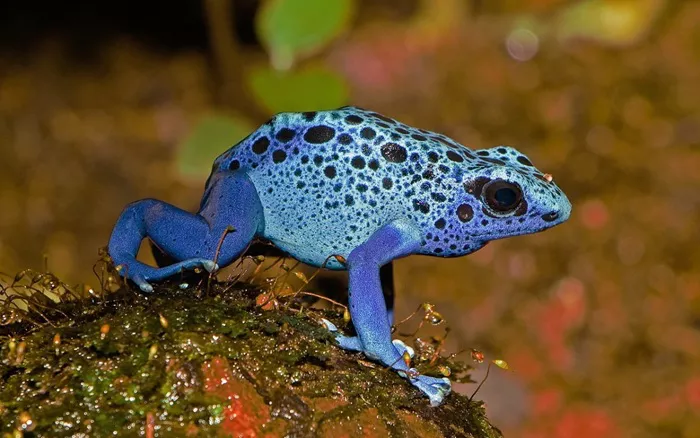
Blue poison dart frogs (Dendrobatoides tinctorius) are among the most striking and mysterious creatures in the animal kingdom. You might already be aware of their vibrant blue coloration and the toxic compounds that give them their name. However, have you ever wondered about their jumping abilities? These tiny, brightly colored frogs are known for their incredible leaps, which serve as both a means of escape from predators and a way to navigate their dense rainforest homes.
But how high and how far can a blue poison dart frog jump? In this article, we will dive deep into this fascinating question, exploring the mechanics of their jumps, the factors that influence them, and why these leaps are crucial for their survival.
The Anatomy of a Blue Poison Dart Frog
Before we talk about jumping, let’s first understand what makes these little frogs such powerhouses. Blue poison dart frogs are tiny creatures, typically only about 1.5 to 2.5 cm (0.6 to 1 inch) long, but their powerful legs are what help them make such impressive leaps. Their hind limbs are much longer and stronger than their forelimbs, which is common in jumping animals.
In fact, their strong hind legs are similar to the rear legs of a grasshopper or kangaroo, both of which are known for their extraordinary jumping abilities. Imagine the spring in a trampoline or the energy stored in a slingshot — the blue poison dart frog uses its strong leg muscles in a similar way, building up energy before releasing it in a sudden burst.
The Science Behind the Jump
When it comes to how far and how high a blue poison dart frog can jump, the answer is influenced by a combination of muscle power, body size, and the need for speed. Studies show that these frogs can jump up to 1.5 meters (5 feet) horizontally in a single leap, which is an impressive distance considering their small size. In terms of vertical jumping, they can reach heights of around 0.5 meters (1.6 feet), which is nearly 50 times their body length! That’s like a human jumping the length of a bus.
See Also: What Are the Unique Defenses of Blue Poison Dart Frogs?
To achieve this, blue poison dart frogs rely on the power of their hind legs, which store elastic energy when the frog crouches down. When they spring forward, all that energy is released, propelling them through the air. This explosive force allows them to cover large distances quickly, escaping predators or leaping from branch to branch in the dense forest underbrush.
Why Do Blue Poison Dart Frogs Jump?
Like all jumping animals, the ability to leap is essential for survival. For the blue poison dart frog, jumping isn’t just about covering ground — it’s about avoiding danger. In the wild, they face threats from a variety of predators, including birds, reptiles, and larger amphibians. When startled, the blue poison dart frog can make a quick, powerful escape.
Also, jumping allows them to reach new areas to find food, mates, and shelter. They are primarily insectivores, preying on ants, termites, and small arthropods, which they find by hopping around the forest floor and low vegetation. The ability to jump long distances helps them explore their environment efficiently.
How Does the Terrain Affect Their Jump?
It’s important to note that not all terrain is equal when it comes to jumping. Blue poison dart frogs live in the humid rainforests of Central and South America, where the forest floor is covered in dense foliage and small puddles of water. This environment requires the frogs to be able to jump not just over obstacles, but across uneven ground, avoiding both predators and potential environmental hazards.
On smooth, level surfaces, the frog’s jumping capabilities are at their peak. However, in more rugged terrain, such as the wet, slippery leaves of the rainforest floor, their jumps may not travel as far. The humidity and wetness of the environment also impact the frog’s energy levels. When it’s raining heavily, frogs tend to be less active, as they conserve energy for when conditions are more favorable.
Comparing Jumping to Other Amphibians
Now, let’s make things a little more fun by comparing the jumping abilities of the blue poison dart frog to other well-known amphibians. The common frog (Rana temporaria), which is a much larger species, can jump only about 1 meter (3.3 feet) horizontally. Blue poison dart frogs, on the other hand, can leap almost 1.5 meters, despite being much smaller. This demonstrates that size isn’t the only factor that determines jumping ability. Rather, it’s the specialized musculature and the frog’s unique physiology that allow for such impressive feats.
In fact, blue poison dart frogs are far better at jumping than many other amphibians. Take the bullfrog (Rana catesbeiana), for instance, which is known for its strong jumping abilities, but still doesn’t come close to matching the leaps of a dart frog. The dart frog’s muscles, skeletal structure, and jumping mechanics allow it to cover much greater distances relative to its body size.
Interesting Facts About Their Leaps
Speed: Blue poison dart frogs can make a quick escape from predators. Their jumps are not only long but fast, enabling them to dodge attacks from predators like birds and snakes.
Conservation of Energy: While their jumps are powerful, blue poison dart frogs don’t jump all the time. They reserve their energy for when they really need it — like when a predator is near or when they need to cross a large gap between branches.
Environmental Factors: Interestingly, these frogs’ jumping abilities can be influenced by environmental factors such as temperature and humidity. Cooler temperatures might reduce their energy levels, making them less likely to leap great distances. So, you might find them hopping less when the weather is chilly!
How High and Far Do They Jump in Captivity?
If you’re a reptile enthusiast and keep blue poison dart frogs as pets, you may be wondering how their jumping abilities compare in captivity. Interestingly, in controlled environments like vivariums or terrariums, blue poison dart frogs often jump shorter distances compared to their wild counterparts. This is largely due to the limited space available and the absence of the need to escape predators.
In captivity, however, these frogs still retain their impressive leaping ability, especially when they are startled or excited. It’s a good idea to ensure your enclosure has a variety of structures, such as branches and plants, to mimic their natural habitat and give them the opportunity to exercise their jumping skills.
Conclusion
Blue poison dart frogs may be small, but they possess an incredible ability to jump both high and far. Their powerful hind legs, combined with their specialized physiology, allow them to leap distances up to 1.5 meters horizontally and 0.5 meters vertically. This skill helps them evade predators, find food, and navigate their dense rainforest environments. While they may not always use this ability to its fullest, the fact that they can jump so far makes them stand out in the world of amphibians.
For those lucky enough to witness these frogs in action, their leaps are a truly awe-inspiring sight. Whether you’re a frog enthusiast or just curious about the amazing capabilities of this little amphibian, the blue poison dart frog’s jumping ability is something you shouldn’t miss.
Related topics: