
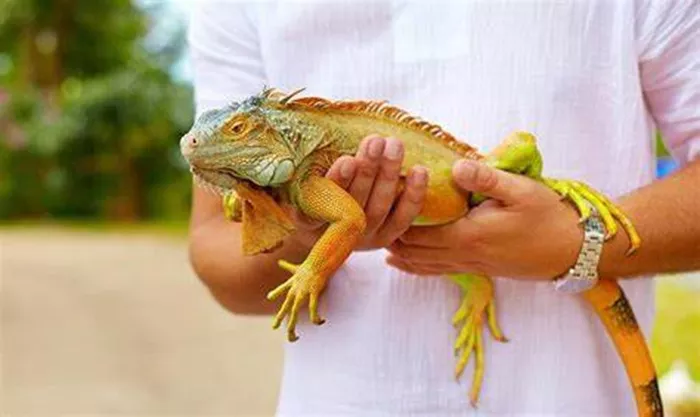
Iguanas are fascinating creatures, admired for their unique appearance, behaviors, and the complexity of their biological systems. One of the common questions many pet owners have is whether iguanas can remember people, especially their owners. This question sparks curiosity, as it touches upon the broader topic of reptilian intelligence and memory. While reptiles like iguanas are often seen as less capable of forming emotional bonds compared to mammals, research suggests they possess certain cognitive abilities that allow them to recognize familiar individuals.
In this article, we will delve into the mechanisms of iguana memory, how they process information, and the likelihood that they can recognize and remember people. We will also explore the differences in memory systems between reptiles and mammals, and whether iguanas are capable of forming lasting bonds with humans.
What is Memory in Reptiles?
Before diving into whether iguanas specifically remember people, it’s essential to understand how memory works in reptiles. Memory, in a general sense, refers to the ability to store, retain, and recall information. This cognitive function varies significantly across species, with different animals exhibiting different levels of memory complexity.
Reptiles, including iguanas, have a simpler brain structure compared to mammals. They primarily rely on the brain’s reptilian complex, which is involved in basic survival functions like instinctive behavior, coordination, and memory. While reptiles lack the highly developed neocortex of mammals, they still possess the ability to retain information, albeit in a more basic form.
Iguanas and Their Sensory Perception
To understand whether iguanas can remember people, it’s crucial to first look at how they perceive the world. Iguanas, like other reptiles, rely heavily on their visual and olfactory senses. Their keen eyesight allows them to detect movement from a distance, and they can recognize shapes, colors, and patterns. This visual acuity plays a significant role in how they might recognize familiar faces or environments.
In addition to vision, iguanas also have a highly developed sense of smell, which they use to detect food and other environmental cues. Smell can be another avenue through which iguanas might recognize their human caretakers, particularly if they associate a particular scent with food or comfort.
How Iguanas Use Their Memory
Iguanas, like many reptiles, use memory to navigate their environment and make decisions related to survival. For example, they can remember locations of food, safe spots, and threats. This suggests that iguanas have the capacity to form memories related to their surroundings and experiences. However, the extent to which they can remember specific individuals, like humans, is less clear and is the subject of ongoing research.
One aspect that can shed light on this question is associative memory, which is the ability to link one stimulus with another. For example, if an iguana consistently associates a person with food, it may begin to recognize that individual as a source of nourishment. This form of memory could help iguanas “remember” people in the context of routine interactions.
Do Iguanas Remember Their Owners?
The question of whether iguanas remember their owners is tied to how well they can recognize humans and retain this recognition over time. Based on studies and anecdotal evidence from pet owners, it appears that iguanas are capable of recognizing familiar people, especially when those individuals provide food or other forms of positive interaction.
The Role of Positive Reinforcement
Iguanas, like many animals, can be trained through positive reinforcement. This means they can associate specific behaviors with rewards, such as food or attention. Over time, an iguana may learn to recognize the person who consistently provides these rewards. This recognition might not be based on the person’s physical appearance alone but also on the context in which the iguana interacts with them. For example, if an iguana sees a certain person every time it’s fed, the iguana will likely associate that person with the act of feeding and therefore “remember” them.
Iguanas and Bonding
Unlike dogs or cats, which are known for their strong emotional bonds with humans, iguanas form different types of connections. Iguanas are not typically social animals and do not seek out interaction for companionship in the same way mammals might. However, they can develop a degree of familiarity and comfort with their owners, especially if they are regularly handled in a calm and consistent manner.
This bond is not emotional in the way that it might be for a dog, but rather a behavioral familiarity. Iguanas may learn that a specific person is not a threat and that their presence is associated with positive outcomes, like food or safety. Over time, this can create a sense of comfort or recognition toward that individual, although it might not be as strong as the bonds formed by mammals.
Do Iguanas React to Different People?
One way to assess whether iguanas remember people is by observing their reactions to different individuals. Many iguana owners report that their pets behave differently around strangers compared to familiar people. For example, an iguana might be more calm and relaxed around its regular caretaker, while being more defensive or cautious around new people. This suggests that iguanas are capable of distinguishing between individuals based on previous experiences.
The Role of Routine
Another factor that could influence an iguana’s ability to remember people is the routine. Iguanas are creatures of habit and thrive in predictable environments. If a person is part of that routine—whether it’s through feeding, handling, or other regular activities—the iguana may associate them with certain actions or rewards. This could contribute to the iguana’s memory of that person.
Scientific Studies on Reptilian Memory
Although research on reptilian memory is still limited compared to studies on mammals, there have been some studies that offer insight into how reptiles like iguanas might remember individuals. Studies on reptiles, including lizards and turtles, show that they are capable of forming memories related to both short- and long-term experiences.
For instance, one study demonstrated that turtles could navigate mazes after being trained to associate certain paths with rewards. This suggests that reptiles have the capacity for both spatial memory (remembering locations) and associative memory (connecting individuals with certain outcomes). Similar studies with other reptiles, such as geckos, show that they can remember specific people and situations after being repeatedly exposed to them.
While there isn’t a definitive study that shows iguanas remember people in the same way that dogs or cats might, it’s reasonable to infer that they are capable of associative memory and can recognize individuals based on prior experiences.
Do Iguanas Remember People Long-Term?
Another important question is whether iguanas can remember people over long periods, such as after an extended period of separation. Iguanas have relatively short lifespans compared to some mammals, typically living 10 to 20 years, depending on species and care. However, the ability to retain long-term memories could be affected by the iguana’s age, the strength of its prior experiences, and how frequently it interacts with the person in question.
From anecdotal reports, it seems that iguanas may remember people even after several months of separation. Owners who travel and return to find their iguanas recognize them suggest that iguanas can retain memories for extended periods. However, the strength and accuracy of these memories likely depend on how strongly the iguana associates the person with positive or negative experiences.
Conclusion: Can Iguanas Remember People?
In summary, while iguanas may not form emotional bonds with humans the way dogs or cats do, they do possess memory capabilities that allow them to recognize familiar individuals. Their memory likely operates through associative learning, where they connect people with certain actions, such as feeding or safety. Iguanas can distinguish between familiar and unfamiliar people, and they may remember their owners based on routine interactions, visual cues, and scent.
The memory capacity of iguanas is not as sophisticated as that of mammals, but it is clear that these reptiles are not devoid of cognitive abilities. They can recognize familiar faces and respond differently to people they have encountered before, indicating that iguanas do, in fact, remember people to some extent.
Understanding how iguanas perceive and interact with humans helps us appreciate the complexity of these creatures. While their memory may not be as emotionally driven as that of mammals, it is still a fascinating aspect of reptilian behavior that adds to our understanding of their cognitive abilities.
Related topics: