
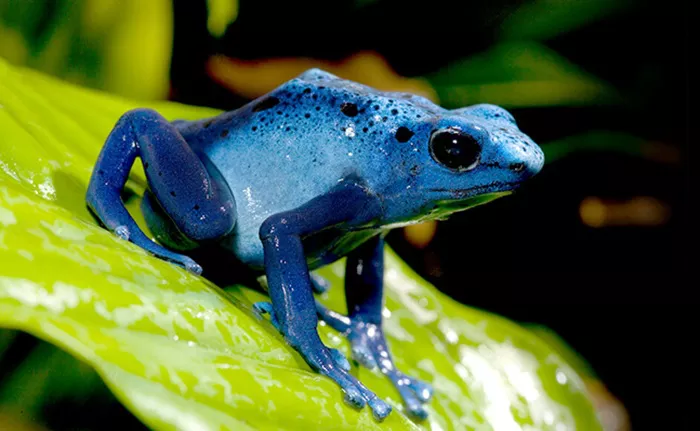
The blue poison dart frog is one of nature’s most vibrant and fascinating creatures. With its striking blue color and potent toxicity, it grabs attention wherever it goes. But have you ever wondered what class it belongs to? You’re about to find out! In this article, we’ll dive deep into the blue poison dart frog‘s classification, explain its biological significance, and break down complex terms in a way that everyone can understand. Let’s get started!
The Core Question: What Class Does the Blue Poison Dart Frog Belong To?
At first glance, the blue poison dart frog might look like something out of a science fiction movie. Its brilliant blue skin, covered in black spots, is enough to make anyone stop in their tracks. But beneath this eye-catching appearance lies a fascinating classification that tells us a lot about how the frog lives and interacts with its environment.
In biological terms, the blue poison dart frog belongs to the class Amphibia. This class includes all amphibians—animals that live part of their lives in water and part on land. You might have encountered amphibians before, like frogs, toads, salamanders, and newts. Amphibians share a few key traits, such as having moist skin, laying eggs in water, and going through a metamorphic life cycle, which means they start life in one form (like a tadpole) and change into another (like an adult frog).
So, why is the class of an animal important? It helps us understand its basic biology—like how it breathes, reproduces, and survives in its environment. The fact that the blue poison dart frog is in the Amphibia class gives us important clues about its habits, diet, and the type of environment it thrives in.
A Peek into the Blue Poison Dart Frog’s World
Now that you know the class, let’s dive a little deeper into what makes this frog so unique. The blue poison dart frog is a member of the Dendrobatidae family, which is a group of frogs known for their bright colors and toxic skin. These frogs don’t make their own toxins; they absorb them from the food they eat, particularly ants, termites, and other small insects. When you see a blue poison dart frog, its vibrant skin isn’t just for show—it’s a warning to predators, telling them not to mess with it. Pretty cool, right?
The blue poison dart frog is also an expert at camouflage, despite its bright blue color. In its natural habitat, the rainforests of Central and South America, the frogs blend well with their environment, hiding among the blue and purple flowers that grow in the moist soil.
How the Class Affects Their Behavior
Being part of the Amphibia class means that blue poison dart frogs must stay close to moisture. Their skin is porous and can easily dry out if they are not kept in a humid environment. In the wild, these frogs live in tropical rainforests where the air is always damp, and water sources like puddles or streams are never too far away.
Understanding the Terms: What Does “Class” Mean?
To fully understand the significance of the term class, let’s break it down with a simple analogy.
Imagine the animal kingdom is like a huge family. In this family, there are several generations and branches of relatives. The class is like a large group of relatives who share certain characteristics. For example, if we look at mammals, which are in the class Mammalia, all members of this class have hair, give birth to live young, and nurse their babies with milk.
For the blue poison dart frog, the Amphibia class means it has moist, permeable skin, lays eggs in water, and undergoes metamorphosis. These are the characteristics that link it to other amphibians, like common frogs or salamanders.
Why is Classification Important?
Understanding classification helps scientists communicate about different species and their relationships with each other. For example, knowing that the blue poison dart frog is an amphibian allows scientists to predict how it might respond to environmental changes or compare its traits to other amphibians. It’s like having a map to navigate through the vast diversity of life on Earth.
How the Blue Poison Dart Frog Fits into the Animal Kingdom
The animal kingdom is divided into broad categories, starting with kingdom, phylum, class, order, family, genus, and finally species. Here’s a quick breakdown of how the blue poison dart frog is classified:
Kingdom: Animalia (Animals)
Phylum: Chordata (Animals with a backbone)
Class: Amphibia (Amphibians)
Order: Anura (Frogs and toads)
Family: Dendrobatidae (Poison dart frogs)
Genus: Dendrobatoides
Species: Dendrobatoides tinctorius (Blue poison dart frog)
Interesting Facts about Blue Poison Dart Frogs
Toxicity: The blue poison dart frog is toxic due to its diet of certain insects. In captivity, where they do not have access to these insects, they lose their toxicity.
See Also: How Do Blue Poison Dart Frogs Get Their Color?
Metamorphosis: Just like many other amphibians, the blue poison dart frog starts life as a tadpole, swimming in water. Over time, it undergoes metamorphosis, turning into a frog.
Rainforest Habitat: These frogs are found in the rainforests of Central and South America. Their bright blue skin helps them blend in with the colorful flora of the rainforest.
Predator Defense: Their bright coloration serves as a warning to predators that they are poisonous. Predators quickly learn to avoid them.
How Do These Frogs Help Us Understand the World?
These frogs may seem small and simple, but they play an important role in our understanding of biodiversity and conservation. By studying animals like the blue poison dart frog, scientists can learn more about ecosystems, food chains, and the balance of nature. Plus, their striking color and behavior teach us a lot about evolution, animal defense strategies, and the intricate relationships between species.
Conclusion
In conclusion, the blue poison dart frog belongs to the class Amphibia, a group of animals known for living part of their lives in water and part on land. Their vibrant blue skin and fascinating toxic behavior make them one of the most intriguing creatures in the animal kingdom. Understanding their class helps us better appreciate their role in the ecosystem and the unique characteristics that make them both beautiful and dangerous.
Related topics: