
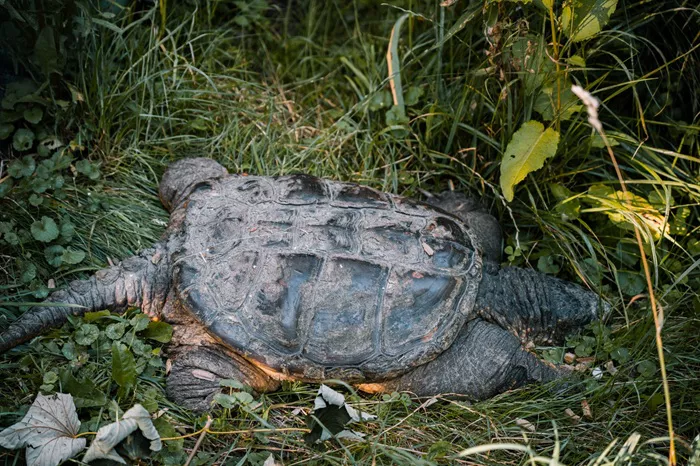
Have you ever wondered whether snapping turtles, those ancient-looking reptiles, could actually be dinosaurs? Their rough, armored shells and slow movements might make them seem like creatures from a bygone era, much like the mighty dinosaurs. But are they truly related to the massive lizards of the Mesozoic era? In this article, we’ll dive deep into the fascinating world of snapping turtles, exploring their evolutionary history, physical characteristics, and their place in the reptilian family tree.
What Are Snapping Turtles?
Before we jump into whether snapping turtles are dinosaurs, let’s first understand what these creatures really are. Snapping turtles are large freshwater reptiles known for their strong, powerful jaws and long tails. These turtles are divided into two main species: the Common Snapping Turtle (Chelydra serpentina) and the Alligator Snapping Turtle (Macrochelys temminckii).
Unlike other turtles, which tend to retreat into their shells when threatened, snapping turtles are known for their aggressive behavior. They get their name from their ability to “snap” with impressive force, particularly when they feel threatened. These turtles can be found in rivers, lakes, and ponds across North America.
The Evolutionary History of Snapping Turtles
So, are snapping turtles dinosaurs? To answer this question, let’s first explore their evolutionary background. Dinosaurs, as we know them, were reptiles that lived during the Mesozoic Era, approximately 230 to 65 million years ago. They belong to a group known as archosaurs, which includes crocodiles, birds, and of course, dinosaurs.
On the other hand, turtles belong to a separate group of reptiles called Testudines. Turtles, including snapping turtles, evolved around 200 million years ago, making them some of the oldest surviving reptiles on the planet. While they share a common ancestor with dinosaurs, snapping turtles are not considered dinosaurs. They’re simply a different branch on the reptilian family tree.
Think of it this way: Imagine the reptilian family tree as a giant map. Dinosaurs are one set of paths, while turtles follow a different road. They may have shared some ancestors, but they’ve gone in different directions for millions of years.
Snapping Turtles and Dinosaurs: A Shared History?
Despite not being dinosaurs, snapping turtles are indeed ancient reptiles that can give us a glimpse into the distant past. The key to understanding their history lies in their evolutionary lineage. Snapping turtles, like all modern turtles, belong to a group of reptiles known as Testudines, which first appeared around the same time as early dinosaurs.
The most intriguing thing about snapping turtles is how much they have changed very little over millions of years. Just like the Alligator Snapping Turtle, which looks almost identical to fossils from the Cretaceous period, modern snapping turtles resemble the ancient reptiles that roamed the earth millions of years ago. This phenomenon is called evolutionary stasis. It means that the species hasn’t had to adapt drastically to survive, largely because their environment remained relatively stable over time.
So, while snapping turtles are not technically dinosaurs, they have evolved alongside them and survived many of the same global changes. Think of them as living fossils—reptiles that have been around for millions of years and offer us a window into the prehistoric world.
Physical Characteristics: Why Do Snapping Turtles Look So Ancient?
You’ve probably noticed that snapping turtles look a bit like creatures straight out of a Jurassic Park movie. With their thick, armored shells and rugged features, they have a prehistoric appearance. But what makes them look so “dinosaur-like”? There are several physical characteristics that contribute to their ancient look.
1. The Armored Shell
One of the most striking features of snapping turtles is their tough, bony shell. This protective armor has been around for hundreds of millions of years, designed to protect the turtle from predators. While dinosaurs evolved a variety of defense mechanisms—such as large size, sharp teeth, or tough skin—turtles evolved to hide in their shells for safety. Their shells are made of bony plates that have been fused together, making them incredibly strong.
2. The Long Tail
Snapping turtles also have a long, muscular tail that helps them balance when swimming. This tail gives them an ancient, almost dinosaur-like appearance, and it’s a key feature for their survival in the wild. In fact, the Alligator Snapping Turtle has a tail so long and thick that it often looks like an extension of its body rather than a separate limb.
3. Powerful Jaws
Another striking feature of snapping turtles is their powerful jaws. Their beak-like mouth can snap shut with incredible force, similar to the bite of a crocodile or even some species of dinosaurs. This biting power allows them to catch and eat prey that many other reptiles would have trouble with.
4. The Ancient Look
There’s no denying it: snapping turtles just look ancient. Their rough, textured skin and mottled shell give them an appearance that seems frozen in time. This visual similarity to ancient reptiles is what often leads people to think of them as “living dinosaurs.”
How Have Snapping Turtles Survived So Long?
So, if snapping turtles aren’t dinosaurs, how have they managed to survive for so long? One of the main reasons is their adaptability. Turtles are highly resilient creatures that can live in a variety of environments, from freshwater lakes to brackish coastal waters.
Additionally, snapping turtles are cold-blooded (like all reptiles), which means they can survive in a wide range of temperatures. In fact, some species of snapping turtles can hibernate for months during the winter, which gives them a survival advantage when food is scarce.
But their survival isn’t just about their ability to adapt to different conditions—it’s also about their slow evolution. Because they don’t need to change much to survive, snapping turtles are an example of how certain species can thrive by keeping things simple. In this way, they’re similar to some of the most resilient creatures in the world, like cockroaches or sharks.
Are There Any Modern Day “Dinosaurs”?
While snapping turtles are often called “living fossils,” it’s important to clarify that they are not dinosaurs. However, there are certain living reptiles today that are considered more closely related to dinosaurs, such as crocodiles and alligators. These animals share a common ancestor with dinosaurs and are often considered the closest living relatives to the mighty creatures that once ruled the Earth.
The relationship between snapping turtles and dinosaurs is more like distant cousins who share a family tree but have evolved down different paths. While snapping turtles may not be dinosaurs, they still have a fascinating evolutionary history that connects them to the distant past.
Conclusion
To wrap up, snapping turtles are not dinosaurs, but they are certainly ancient reptiles that have been around for millions of years. Their appearance, behavior, and evolutionary history make them living fossils—reptiles that have survived through the ages. While they share a common ancestor with dinosaurs, snapping turtles belong to a completely different branch of the reptilian family tree.
So, the next time you encounter a snapping turtle, remember: while they might look like creatures from the age of dinosaurs, they are part of a different, yet equally fascinating, evolutionary story.
Related topics: