
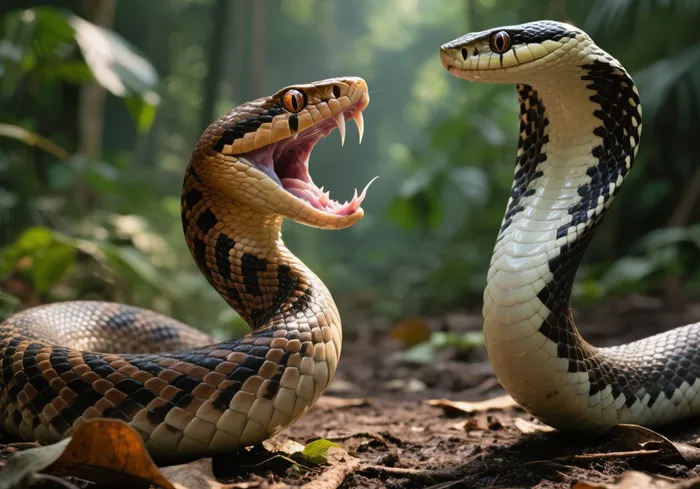
When we think of venomous snakes, two names often rise to the surface: the Gaboon Viper and the King Cobra. These creatures are both awe-inspiring and terrifying in their own right, each representing the pinnacle of reptilian defense and attack strategies. But what would happen if these two venomous giants faced off in the wild? Let’s dive into an exciting comparison between the Gaboon Viper and the King Cobra, two of the most famous and feared serpents on the planet.
Introduction: The Clash of Titans
Imagine standing in a dense, humid jungle, feeling the weight of heat pressing down on you. Suddenly, you spot a striking, colorful figure coiled on the forest floor. Is it a Gaboon Viper ready to ambush its prey? Or perhaps it’s the massive King Cobra, a symbol of power and grace, slithering through the underbrush? Both species are among the largest and most dangerous reptiles, but in very different ways.
The Gaboon Viper (Bitis gabonica) is famous for its large size, impressive camouflage, and potent venom. It is a pit viper found in the rainforests of Africa, and it is often regarded as the deadliest viper species. On the other hand, the King Cobra (Ophiophagus hannah) is the longest venomous snake in the world and is native to Asia. Known for its intelligence and massive hood, the King Cobra strikes fear into all who cross its path.
But how do these two reptiles stack up against one another? Let’s break it down.
The Gaboon Viper: A Master of Stealth and Power
The Gaboon Viper is truly an embodiment of nature’s brilliance. Often described as “the ghost of the rainforest,” this snake has an appearance that helps it remain virtually invisible to predators and prey alike. It uses its surroundings to blend into the forest floor with remarkable effectiveness.
Physical Characteristics:
The Gaboon Viper is a large snake, reaching lengths of up to 6 feet (1.8 meters). Its body is thick, with a triangular-shaped head that matches the colors of the forest floor: browns, blacks, and oranges, allowing it to blend seamlessly with the environment. The Gaboon Viper’s size and coloration make it one of the most intimidating snakes to come across in the wild.
Venomous Bite:
The Gaboon Viper’s venom is potent, containing both cytotoxins (which destroy cells) and neurotoxins (which affect the nervous system). This venom can cause extreme pain, swelling, and necrosis in its victim, even leading to death if untreated. Despite this, the Gaboon Viper is a relatively slow-moving snake, relying on its stealth and ambush tactics rather than chasing down prey. It strikes with lightning speed when threatened or hunting, delivering venom through long fangs that can reach up to 2 inches (5 cm) in length.
Feeding Habits:
The Gaboon Viper is primarily an ambush predator, lying in wait for small mammals, birds, amphibians, and reptiles. Its large size allows it to take down prey that is sometimes larger than it. With its powerful venom, the Gaboon Viper can subdue animals much larger than itself. Interestingly, it often targets ground-dwelling creatures like rodents and birds, taking advantage of its stillness and exceptional camouflage.
In summary, the Gaboon Viper is a master of surprise. It relies on its camouflage, powerful venom, and ambush strategies to survive, making it an apex predator in its environment.
See Also: Where to Buy a Gaboon Viper?
The King Cobra: The Majesty of the Jungle
If the Gaboon Viper is a stealthy ambush predator, the King Cobra is a royal hunter, commanding respect and fear wherever it goes. Known for its intelligence and massive size, the King Cobra has earned its title as the largest venomous snake in the world.
Physical Characteristics:
The King Cobra can reach lengths of up to 18 feet (5.5 meters), though it typically averages around 12 feet (3.7 meters). Its long, slender body is built for speed, while its impressive hood—used to intimidate threats—is a hallmark of its menacing appearance. The King Cobra’s coloration varies from olive green to dark brown, with lighter stripes that can help it blend into the forest or jungle floor.
Venomous Bite:
The King Cobra’s venom is potent, targeting the nervous system of its victims. Unlike the Gaboon Viper, which uses a combination of venom for both defense and predation, the King Cobra primarily uses its venom to kill large prey, such as other snakes, lizards, and even small mammals. A single bite can deliver a lethal dose of venom, capable of killing a large animal within hours. However, unlike the Gaboon Viper, the King Cobra has smaller fangs, and it tends to strike multiple times in quick succession.
Feeding Habits:
The King Cobra’s diet mainly consists of other snakes, including venomous species. It is one of the few reptiles that actively hunt other snakes, making it an apex predator in the world of serpents. Its ability to subdue venomous snakes, such as kraits and other cobras, is a testament to its agility, strength, and venom. The King Cobra can also go without food for long periods, sometimes weeks, thanks to its ability to consume large meals at once.
In summary, the King Cobra is a formidable force in the snake world. Its immense size, intelligence, and venom make it a true predator. Unlike the Gaboon Viper, it is an active hunter, relentlessly pursuing its prey with efficiency and strength.
The Showdown: Gaboon Viper vs King Cobra
Now that we know what each snake brings to the table, let’s consider what would happen if they were to face off. Both the Gaboon Viper and the King Cobra are incredibly dangerous, but their strategies for survival and combat are quite different.
Speed and Agility:
The King Cobra is faster and more agile than the Gaboon Viper, thanks to its long, slender body. It could potentially strike faster, and its ability to control its movements with precision would give it the upper hand in an open confrontation. The Gaboon Viper, on the other hand, relies on its camouflage and ambush strategy. It is not as quick as the King Cobra, but its powerful venom could still deliver a lethal blow if it were to strike first.
Venomous Impact:
Both snakes possess highly toxic venom, but the King Cobra’s venom is more specialized in affecting the nervous system. It could potentially paralyze its victim quickly. The Gaboon Viper’s venom, while also extremely toxic, works more slowly, affecting tissues and causing more localized damage. The Gaboon Viper would likely rely on its venom to weaken the King Cobra, while the King Cobra would aim for a swift kill.
Size and Strength:
The King Cobra is larger, stronger, and more aggressive than the Gaboon Viper. It can overpower a smaller opponent like the Gaboon Viper with its strength and relentless nature. However, the Gaboon Viper’s size is not insignificant either, and it could pose a significant threat to a King Cobra if it manages to deliver a venomous bite.
Conclusion: In an actual confrontation, the King Cobra would likely have the upper hand due to its agility, size, and intelligence. However, the Gaboon Viper’s ability to ambush and its powerful venom make it a dangerous adversary, capable of taking down even the most formidable opponents if given the opportunity.
Conclusion
Both the Gaboon Viper and the King Cobra are magnificent creatures in their own right. The Gaboon Viper’s ability to blend in and strike with deadly precision, and the King Cobra’s intelligence and strength, make them two of the most feared snakes on the planet. While they come from different parts of the world and have unique survival strategies, both snakes represent the mastery of nature in their respective environments.
When you encounter these creatures in the wild, whether in the jungles of Africa or the forests of Asia, you are witnessing the culmination of millions of years of evolution. It’s a reminder that, while we may have conquered much of the earth, the world of reptiles is still full of wonders and dangers we can barely comprehend.
Related topics: