
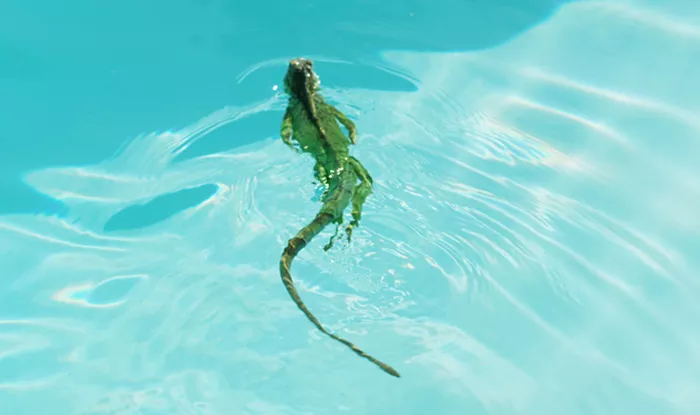
Iguanas are one of the most fascinating and unique reptiles, often found in tropical environments. Their abilities to adapt to various habitats and their distinct appearance have made them a subject of interest among both pet owners and nature enthusiasts. But one question that often arises when discussing these remarkable creatures is: Can iguanas swim?
In this article, we will explore the swimming capabilities of iguanas, focusing on their natural habitats, anatomy, behaviors, and how these factors contribute to their swimming abilities. We will also address how pet owners can provide appropriate care for iguanas, especially when it comes to ensuring they have access to water for swimming or soaking.
Iguanas and Their Natural Habitat
Iguanas are native to the Americas, primarily found in tropical and subtropical regions. The most common species, the green iguana (Iguana iguana), can be found in Central and South America, often in rainforests or along riverbanks. Their natural habitat often includes areas with access to water, such as rivers, lakes, and coastal areas. This access to water is crucial not only for drinking but also for their ability to cool off and find food.
In the wild, iguanas are semi-arboreal, meaning they spend part of their time in trees and the other part on the ground or near water. They are excellent climbers and enjoy basking in the sun on branches or rocks, but they also have a strong connection to water. Their ability to swim is not just a survival trait but also a behavioral adaptation that helps them in their daily lives.
Anatomy and Adaptations for Swimming
Iguanas are well-equipped for swimming. Their long, muscular tails are perhaps the most important feature that aids in their aquatic movement. These tails act like rudders, helping the iguana navigate through water with precision and speed. When swimming, iguanas use their tail to propel themselves forward, much like how fish or other aquatic reptiles use their tails for movement.
In addition to their tail, iguanas have webbed feet that assist in swimming. While not as developed as those of some amphibians or marine animals, their feet are adapted to provide some grip and thrust in the water. The shape of their body is also streamlined, allowing them to move more efficiently through the water.
One of the most impressive features of iguanas is their ability to hold their breath for extended periods. While underwater, they can remain submerged for several minutes, which allows them to escape predators or navigate underwater environments with ease.
Do Iguanas Swim in the Wild?
In their natural habitat, iguanas are often seen swimming in rivers, streams, and even oceans. Swimming is an essential part of their behavior, especially for species that live near coastlines. For example, the marine iguana (Amblyrhynchus cristatus) of the Galápagos Islands is a well-known swimmer, famous for its ability to dive into the ocean to forage for algae. This species is particularly adapted to life in the water, using its strong limbs and tail to propel itself while hunting underwater.
Green iguanas, while not as adapted for marine environments as the Galápagos species, are also proficient swimmers. They often swim to escape predators, to forage for food, or to find new habitats. Iguanas are also known to swim across rivers and lakes to establish new territories or migrate to different areas when resources in their current location become scarce.
Iguanas as Pets: Can They Swim?
Many people who keep iguanas as pets wonder whether their iguana will enjoy swimming or if they should encourage this behavior. While domestic iguanas may not have the same opportunity for free swimming as their wild counterparts, they still have a natural inclination to swim if given the chance.
It’s important for pet owners to recognize that while iguanas can swim, they should never be forced into water or left unsupervised near it. Iguanas can swim, but they can also tire quickly if they are not used to the water or if they feel stressed. It’s always a good idea to provide a shallow area where your iguana can soak in water, as this helps with hydration, skin shedding, and overall well-being.
However, if you’re planning to allow your iguana to swim, here are a few key considerations:
Water Depth: Make sure that the water is not too deep. Iguanas should be able to touch the bottom and easily swim or exit the water if needed. Shallow pools or bathtubs work best.
Water Temperature: Iguanas are cold-blooded, so they rely on external heat sources to regulate their body temperature. Ensure the water is warm enough to avoid chilling your iguana, but not too hot to cause harm.
Supervision: Never leave an iguana unattended in water, as they can become disoriented, tired, or stressed. Ensure they always have access to a safe exit.
Enclosure Design: If you’re setting up an enclosure for your iguana, consider including a small pool or water dish large enough for them to soak in. This not only benefits their hydration but also mimics their natural behavior.
How Iguanas Use Swimming for Survival
In the wild, iguanas use their swimming ability primarily for escaping predators. Iguanas are preyed upon by a variety of animals, including birds of prey, snakes, and larger mammals. When threatened, iguanas can quickly jump into the water and swim away to safety.
Another important aspect of their swimming ability is for foraging. Iguanas often forage for food in or near water, especially species that live along coastal regions or in wetlands. By swimming, they can access food sources that might be difficult to reach otherwise.
Social Behavior and Swimming: Some iguana species, particularly those that live in groups, use swimming as a form of social interaction. It’s not uncommon for iguanas to swim together in bodies of water, either to bask in the sun or as part of their daily activities.
The Challenges of Swimming for Pet Iguanas
While iguanas can swim, there are several challenges that pet iguana owners should be aware of. One significant challenge is ensuring that the water in which the iguana swims is both safe and clean. Iguanas can be susceptible to skin infections if they swim in dirty water, so regular cleaning of any water features in their enclosure is essential.
Additionally, iguanas, especially those not accustomed to regular swimming, can become stressed or fatigued if the water conditions are not ideal. Therefore, providing safe and non-threatening water spaces where the iguana can easily escape is crucial.
Conclusion
In summary, iguanas are indeed capable swimmers, and swimming is a natural behavior for many species of iguanas, particularly those that live near water. They use swimming for escape, foraging, and sometimes even as part of their social behavior. While they are not primarily aquatic creatures, their anatomical adaptations, such as their muscular tails and webbed feet, make them skilled swimmers.
For pet iguana owners, providing a safe, shallow water area where the iguana can soak or swim can enhance the iguana’s well-being, but it is essential to monitor the animal to prevent stress or fatigue. Always consider the iguana’s natural behaviors and needs to ensure they thrive in a domestic setting.
Related topics: