
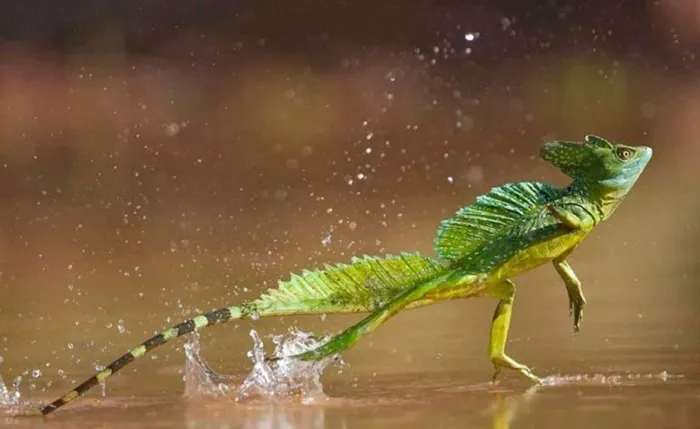
Lizards are fascinating creatures that have evolved to survive in a wide range of habitats. Among them, some species exhibit extraordinary abilities that seem almost impossible. One of the most remarkable abilities observed in lizards is the capacity to run across the surface of water. This article will explore the lizards that can run on water, explain the science behind this phenomenon, and discuss their behavior, habitat, and ecological significance.
The Basilisk Lizard: The Water-Running Specialist
The lizard most famous for its ability to run on water is the Basilisk lizard. Often called the “Jesus Christ lizard” because of this extraordinary skill, the basilisk belongs to the genus Basiliscus. These lizards are primarily found in Central and South America, inhabiting tropical rainforests near rivers and streams.
Physical Adaptations
Basilisk lizards have several unique physical traits that allow them to run on water. They have long toes with fringed scales, which increase surface area and help them stay above water temporarily. Their powerful hind legs provide rapid movement, while their lightweight body reduces the force of gravity acting against them. These adaptations work together to create the water-running ability.
How They Move
When a basilisk lizard runs on water, it moves its legs rapidly in a slapping motion. Each step creates small pockets of air that provide temporary support. Combined with high-speed movement, this allows the lizard to stay on the water surface for several meters before sinking. Young basilisks can run farther on water than adults because of their lower weight.
Behavioral Aspects of Water-Running Lizards
Running on water is not only a physical skill but also a behavioral strategy. Basilisks use this ability primarily to escape predators. In their natural habitat, threats include birds, snakes, and larger mammals. The ability to move quickly across a river or stream provides a crucial survival advantage.
Territorial and Social Behavior
Basilisk lizards are territorial animals. Males often display their water-running ability as a form of display to intimidate rivals or attract mates. This skill demonstrates their agility and strength, both important traits in survival and reproduction.
Other Lizards and Semi-Aquatic Species
While the basilisk is the most famous water-running lizard, other semi-aquatic lizards also exhibit interesting behaviors around water. For example, some species of skinks and anoles can sprint across wet surfaces but cannot truly run on water like the basilisk. These species rely on swimming or climbing to evade threats.
Comparisons With Other Lizards
Unlike the basilisk, most lizards that live near water rely on camouflage, swimming, or diving. The water-running ability is extremely rare and unique to basilisks. Studying these differences helps scientists understand the evolutionary pressures that lead to such specialized adaptations.
The Science Behind Water Running
Understanding how a lizard can run on water requires knowledge of physics and biology. The interaction of weight, surface tension, speed, and foot morphology determines the ability to temporarily stay above water. Scientists have used high-speed cameras and fluid dynamics simulations to study this phenomenon in detail.
Surface Tension and Foot Mechanics
While surface tension plays a minor role, the primary mechanism is the rapid slapping motion of the lizard’s feet. When the foot hits the water, it creates a cavity that traps air. This cavity supports the lizard for a fraction of a second. Repeated fast movements keep the lizard moving across the surface before gravity pulls it down.
Speed and Energy Considerations
Running on water requires extraordinary speed and energy. Basilisks must move their hind legs at over 5 meters per second to remain on the water surface. This energy-intensive activity is usually used in short bursts, mainly during predator escapes.
Habitat and Distribution
Basilisk lizards are found near rivers, streams, and wetlands in tropical rainforests of Central and South America. Countries like Costa Rica, Panama, and Colombia have significant populations. Their preference for habitats with water sources is directly related to their water-running ability, which provides an effective escape route and hunting advantage.
Diet and Hunting
Basilisks are omnivorous, feeding on insects, small animals, fruits, and flowers. Water access allows them to catch prey efficiently and avoid terrestrial predators. Running on water can also aid in hunting by allowing them to traverse rivers and streams quickly.
Ecological Importance
Water-running lizards play a vital role in their ecosystems. By controlling insect populations and serving as prey for larger animals, they maintain ecological balance. Their unique ability also attracts attention from researchers and ecotourists, contributing to local economies and conservation efforts.
Conservation Status
Although basilisk lizards are not currently endangered, their habitats are threatened by deforestation and pollution. Protecting rivers and tropical forests is essential to preserve these remarkable creatures and their extraordinary abilities.
Human Fascination and Scientific Studies
The basilisk lizard’s water-running ability has fascinated humans for centuries. Scientists study their movement to understand biomechanics, fluid dynamics, and evolutionary adaptations. Engineers even look at these lizards for inspiration in robotics and materials science, demonstrating how nature can guide innovation.
Conclusion
The lizard that can run on water is the basilisk, a remarkable example of evolutionary adaptation. Its physical traits, rapid movement, and unique behavior allow it to escape predators and thrive in aquatic environments. While other lizards may live near water, none match the basilisk’s extraordinary ability. Studying these lizards offers insights into biology, physics, and ecology, and highlights the incredible diversity of life on Earth.
Related topics: