
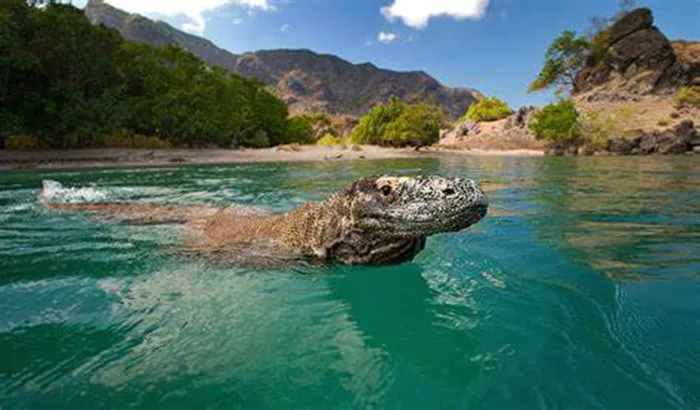
Komodo dragons are the largest living lizards on Earth. These giant reptiles are powerful, fascinating, and sometimes misunderstood. People often wonder about their abilities. One common question is: Can Komodo dragons climb trees?
To answer this question fully, we need to understand their biology, behavior, and habitat. We also need to consider how age and size affect their climbing ability. In this article, we will explore the climbing ability of Komodo dragons in detail. We will also look at the reasons behind this behavior and how it plays a role in their survival.
What Are Komodo Dragons?
Komodo dragons (Varanus komodoensis) are members of the monitor lizard family. They are native to a few islands in Indonesia, including Komodo, Rinca, Flores, and Gili Motang. These reptiles can grow very large. Adult males often reach up to 10 feet (3 meters) in length and weigh around 150 to 200 pounds (70 to 90 kilograms). Some individuals are even larger.
Despite their size, Komodo dragons are strong and fast. They have long tails, strong limbs, and sharp claws. They use these features to hunt, fight, and move through rough terrain. Their forked tongue helps them detect scent particles, allowing them to track prey over long distances.
Komodo Dragons and Their Habitat
Komodo dragons live in tropical savannas, forests, and grasslands. These environments are warm and often dry, but there are also areas with thick vegetation and trees. Trees are a common feature of their habitat, and Komodo dragons interact with them in many ways.
In areas with dense forests, trees provide shade, hiding places, and even food sources for some of the dragon’s prey. While Komodo dragons are mostly ground-dwelling, the presence of trees plays an important role in their life cycle, especially during their early stages of development.
Do Komodo Dragons Climb Trees?
The answer is both yes and no. Young Komodo dragons can climb trees, but adults usually cannot.
Juvenile Komodo dragons are much smaller and lighter than adults. They are agile and strong for their size. This allows them to climb trees easily. In fact, climbing is an important behavior for young dragons. It helps them survive in a dangerous environment.
On the other hand, adult Komodo dragons are very heavy. As they grow, their body weight increases significantly. This makes climbing trees almost impossible for them. Their claws are strong, but they are not adapted for supporting the weight of a full-grown lizard in a vertical climb.
So, the ability to climb is mostly limited to the early life of a Komodo dragon. Let’s take a closer look at how this works.
Why Do Young Komodo Dragons Climb Trees?
There are several important reasons why young Komodo dragons climb trees.
To Avoid Predators
One of the biggest threats to young dragons is other Komodo dragons. Adults are cannibalistic. They often eat the young of their own species. This is a natural behavior that helps reduce competition. However, it is very dangerous for the young.
To survive, juvenile Komodo dragons climb trees to escape these threats. In the trees, they are much safer. Few predators can reach them there, and adult dragons do not usually climb.
To Find Food
Young dragons eat insects, small reptiles, birds, and eggs. Many of these food sources can be found in trees. Climbing helps them access a wider range of food. It also allows them to hunt safely without competing directly with adults on the ground.
To Rest Safely
Trees provide safe places to rest. A young Komodo dragon can sleep in the branches without worrying about predators. From a high place, they can also observe their surroundings more easily.
These advantages are crucial during the early years of life. Juvenile dragons stay in the trees as much as possible until they grow too large to climb.
How Do Komodo Dragons Climb Trees?
Climbing a tree is not easy, especially for a reptile. However, young Komodo dragons have special features that help them.
Their claws are sharp and curved. These claws can grip tree bark, allowing the lizard to pull itself upward. Their limbs are muscular and flexible, giving them the strength and balance they need to climb. Their long tails help them balance while moving vertically.
Young dragons also use a twisting motion while climbing. They press their bodies close to the tree and push with their back legs. At the same time, they pull with their front legs. This motion is very effective for small, light-bodied reptiles.
They are not as graceful as tree-dwelling animals like monkeys or squirrels. Still, they are quite capable climbers when young.
At What Age Do Komodo Dragons Stop Climbing Trees?
Komodo dragons hatch from eggs. When they are born, they are about 16 inches (40 centimeters) long. They grow quickly in the first few years. Most sources suggest that young dragons continue climbing until they reach around 20 to 30 pounds (9 to 14 kilograms). After that, climbing becomes more difficult.
By the age of 3 to 5 years, they may spend more time on the ground. Once they reach adulthood (around 5 to 7 years old), they stop climbing altogether. Their weight, size, and body structure are no longer suited for vertical movement.
However, this transition can vary between individuals. Some young dragons may stop climbing earlier than others. The availability of trees in their environment can also affect this behavior.
Do Adult Komodo Dragons Ever Attempt to Climb?
Adult Komodo dragons almost never climb trees. Their heavy bodies make it extremely hard. However, there are rare reports of adults climbing low branches or leaning trees. In such cases, the tree is not very tall, and the incline is gentle. These are exceptions, not the norm.
More often, adults will use their powerful legs and claws to scramble over rocks or logs. They may lift themselves onto raised platforms or slopes. But vertical climbing into trees is nearly impossible for them.
How Does This Behavior Affect Komodo Dragon Survival?
Climbing ability is a key survival trait for young Komodo dragons. It reduces their risk of being eaten by adults or other predators. It also gives them more access to food and shelter. Without this skill, many young dragons would not survive.
Because adult dragons do not climb, the trees act as a safe zone for the young. This behavior reduces competition between age groups. It allows young dragons to grow safely before they move to the ground and adopt more adult behaviors.
This separation of space—trees for the young, ground for the adults—is a smart strategy. It helps Komodo dragons survive in an ecosystem where resources are limited and predators are many.
Conclusion
So, can Komodo dragons climb trees?The answer is clear: yes, young Komodo dragons can climb trees, but adults cannot. Climbing is an important survival tool for juveniles. It helps them escape predators, find food, and stay safe. As they grow larger, their bodies become too heavy to climb, and they shift to a ground-based lifestyle.
Understanding this behavior helps us see how Komodo dragons live, grow, and survive in their natural environment. It also shows us how important physical traits and behaviors are for survival at different stages of life.
Komodo dragons are not just giant lizards. They are complex animals with a fascinating life cycle. Their ability to climb trees, even if only in their youth, is one more reason why they continue to amaze scientists and nature lovers around the world.
Related topic