
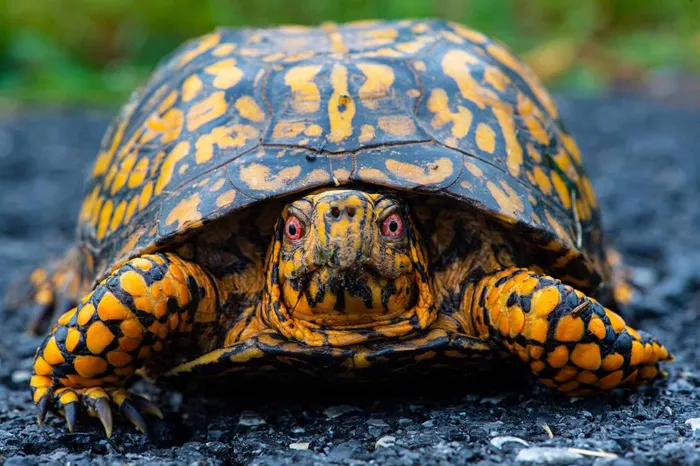
When you think of a turtle, what comes to mind? Maybe an image of a calm creature swimming through the water. Now, picture a tortoise – a land-dwelling reptile slowly strolling across the grass. But, what about the box turtle? Is it a turtle or a tortoise? Does the box turtle belong to the family of water-loving creatures, or is it more at home on land, like a tortoise? Let’s dive into the world of these fascinating reptiles and uncover the truth behind the box turtle’s classification.
What is a Box Turtle?
A box turtle is a unique species of turtle known for its dome-shaped, hard shell and the ability to close its shell tightly, like a “box” (hence the name). They are mainly found in North America, and they are known for their distinctive hinged plastron (the underside of their shell), which allows them to completely enclose themselves when threatened. This ability sets them apart from many other types of turtles and tortoises.
But here’s the big question: Is the box turtle more like a turtle or a tortoise? Let’s break it down by considering key factors like habitat, behavior, diet, and anatomy.
Turtles vs. Tortoises: The Key Differences
Before we can answer the box turtle question, let’s first refresh our memory on the differences between turtles and tortoises, because it’s these differences that will help us understand where the box turtle fits in.
Habitat
Turtles: These reptiles spend most of their lives in or around water. They are often found in freshwater environments like ponds, lakes, and rivers, though some species live in saltwater.
Tortoises: In contrast, tortoises are strictly land-dwelling creatures. They live in a variety of habitats, ranging from deserts to tropical forests.
Physical Characteristics
Turtles: Turtles typically have flatter, more streamlined shells, which help them swim efficiently in the water. Their legs are webbed or paddle-like, ideal for propulsion in aquatic environments.
Tortoises: Tortoises have more rounded, domed shells, and their legs are sturdy and thick, designed for walking on land.
Box Turtles and Their Unique Features
Now, where does the box turtle fit into all this? It’s a bit of a mystery at first because, despite having the name “turtle,” it shares many traits with tortoises, especially in terms of its anatomy and behavior.
Habitat of the Box Turtle
Box turtles are terrestrial creatures, meaning they live primarily on land. Unlike aquatic turtles, box turtles aren’t found swimming in ponds or oceans. They prefer woodlands, grasslands, and wetlands where they can forage for food and hide from predators. Some species may be found in environments with low moisture, such as dry, sandy soils.
However, box turtles still need access to water sources for drinking and occasional soaking. This makes them a little of both – they’re primarily land dwellers, but they still require some moisture, much like the aquatic turtles.
Physical Traits: A Fusion of Both Worlds
The shell of a box turtle is quite unique. While tortoises have more sturdy, domed shells, box turtles feature a dome-shaped, hinged plastron that allows them to completely close up when threatened. The hinge of the shell is a remarkable feature that distinguishes them from most other land-dwelling reptiles.
The box turtle’s legs, however, are not as thick as those of tortoises but are more robust than aquatic turtles’ webbed legs. This adaptation helps box turtles travel over land without tiring easily, although they are not built for long-distance travel like tortoises.
Behavior of a Box Turtle: More Tortoise or Turtle?
Diet and Feeding Habits
When it comes to diet, box turtles are omnivores, much like tortoises. They enjoy a wide range of food, from plants like berries, leaves, and mushrooms, to small insects, such as worms, snails, and beetles. Tortoises also tend to be herbivores, while many turtles primarily eat aquatic plants or fish. The box turtle’s mixed diet further emphasizes its unique position between tortoises and aquatic turtles.
See Also: Where Do Box Turtles Live?
Activity Patterns
Box turtles tend to be more active during the day (diurnal), which aligns more closely with tortoises than aquatic turtles, which are often more active at night. They also spend a lot of time basking in the sun, something that tortoises do as well. This behavior is partly to regulate their body temperature, as box turtles are cold-blooded like all reptiles.
The Classification Debate: Turtle or Tortoise?
So, when you ask, “Is a box turtle a turtle or a tortoise?” the answer is not as straightforward as you might expect. Box turtles share traits with both turtles and tortoises, making them a fascinating species to study.
Anatomy and Behavior Similarities with Tortoises:
−Box turtles have land-dwelling habits.
−They have domed, sturdy shells like tortoises.
−They are slow-moving and rely on their shells for protection.
Similarities with Turtles:
−Box turtles are still classified as turtles by scientists, even though they resemble tortoises in many ways.
−They require water to drink and occasionally soak, though they don’t spend most of their time in water.
Therefore, box turtles are classified within the order Testudines (the same as all turtles), but due to their land-dwelling nature and unique traits, they are closer to tortoises in some ways.
Box Turtle Species and Their Conservation Status
There are several species of box turtles, each with its own unique characteristics. Some species are critically endangered, and habitat loss, pollution, and illegal pet trade have led to a significant decline in their populations.
For example, the Eastern box turtle (Terrapene carolina carolina) is one of the most well-known species, often seen in forests and grasslands in the Eastern United States. Conservation efforts are essential to protect their habitats and prevent further decline.
Conclusion
In conclusion, a box turtle isn’t purely a turtle, nor is it strictly a tortoise. It’s a unique blend of both, making it one of the most fascinating species in the world of reptiles. Whether it’s in its land-dwelling lifestyle or its semi-aquatic needs, the box turtle truly defies simple categorization.
Next time you encounter a box turtle, you’ll know it’s a turtle at heart, but with many tortoise-like qualities. Don’t miss the chance to admire one of nature’s most adaptable reptiles!
Related topics: