
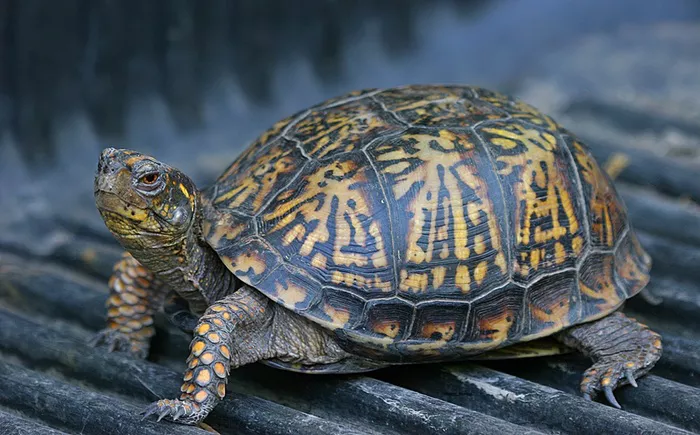
Eastern box turtles (Terrapene carolina carolina) are one of the most beloved terrestrial turtles in North America. They live in wooded habitats, forest edges, and moist meadows from the eastern United States all the way to the Great Lakes. Many people keep these turtles as pets or study them in the wild. But one common and important question often arises: How can you tell if an Eastern box turtle is male or female?
Unlike mammals, turtles do not have external reproductive organs that make their sex immediately obvious. However, there are several clues that can help determine their gender. These include differences in their size, shell shape, eye color, claw length, tail thickness, and even the color of their throat and skin. Some features are more reliable than others, especially when looking at adult turtles. Juveniles are harder to sex and may need to be examined over time.
This guide is written by a zoologist and aims to help turtle owners, field researchers, and wildlife enthusiasts understand the differences between male and female Eastern box turtles. It will walk you through both subtle and visible characteristics, explain how to interpret them, and offer tips for minimizing mistakes in identification. The language is simple, the structure is logical, and the article aims to provide an in-depth answer to this fascinating biological question.
Why Turtle Sex Identification Matters
Determining the sex of your Eastern box turtle can help with many things. If you’re a breeder, you need to know which turtles are males and which are females to manage your breeding stock. If you’re a conservationist, understanding sex ratios in a population helps assess the health of wild populations. For pet owners, knowing your turtle’s sex can help anticipate certain behaviors such as nesting or territorial aggression.
In nature, the balance between males and females can change due to environmental factors. For example, temperature can influence the sex of hatchlings. If too many males or females are produced, it can disrupt future generations. That’s why proper sex identification is crucial in both the wild and captivity.
What Age Is Best for Sexing?
Before trying to tell whether your turtle is male or female, you need to consider its age. Most Eastern box turtles reach sexual maturity between 5 and 7 years old, though some may mature earlier or later depending on diet, habitat, and genetics.
Immature turtles often lack the distinct features that help in sexing. Juveniles are small and may not show clear differences in eye color, tail length, or plastron shape. In general, it is best to wait until the turtle is at least 4 inches long and has reached maturity before trying to identify its sex with confidence.
Sexual Dimorphism in Box Turtles
In biology, sexual dimorphism refers to physical differences between males and females of the same species. Eastern box turtles exhibit several types of sexual dimorphism. Some are subtle, while others are fairly distinct.
Below, we will break down the most reliable and observable differences.
1. Eye Color
Eye color is one of the most talked-about traits when sexing an Eastern box turtle. Though not always 100% accurate, it provides a helpful clue.
−Males usually have bright red or orange eyes.
−Females often have brown or dark reddish-brown eyes.
However, eye color alone is not foolproof. Some males have dark eyes, and some females have slightly red tones. It should always be used with other signs.
2. Shell Shape (Plastron and Carapace)
Turtles have two main shell parts:
−The carapace is the top shell.
−The plastron is the bottom shell.
Plastron Shape:
−Males have a concave (curved inwards) plastron. This helps them mount the female during mating.
−Females have a flat or slightly convex (curved outward) plastron to make room for eggs.
Carapace Shape:
−Some males may have a slightly more elongated carapace.
−Females sometimes appear rounder and broader, especially around the rear end.
Again, these are general trends, and individual turtles may vary. The plastron shape is usually a more dependable indicator than the carapace.
3. Tail Length and Thickness
The tail offers one of the most consistent differences between males and females.
−Males have longer, thicker tails. Their vent (cloaca) is located farther from the base of the tail.
−Females have shorter, thinner tails, and their cloaca is positioned closer to the body.
To check this safely, gently lift the turtle’s tail without causing stress or harm. Always be gentle, and never pull or twist the tail.
4. Rear Claw and Leg Size
This feature is more subtle but can still be helpful when comparing multiple turtles.
−Males tend to have longer and more curved rear claws, which help during mating.
−Females usually have shorter, straighter claws, more suited for digging nests.
Again, this trait is most useful when combined with other indicators.
5. Coloration and Skin Tone
Some differences in color patterns can suggest sex:
−Males often have brighter markings on the head, legs, and front limbs.
−Females may appear more muted in
Some males may have vibrant orange or yellow spots on their legs and jaws. But not all males show this, and some females can also have colorful patterns. Use this as a secondary clue.
6. Vent
The vent or cloaca is the opening at the tail’s underside used for reproduction and excretion. Its location differs between sexes.
−In males, the vent is located farther down the tail, past the edge of the plastron.
−In females, it is found closer to the plastron’s edge, under the tail base.
This difference becomes clearer in sexually mature turtles. You may need to gently lift the turtle’s tail to observe the vent location.
7. Behavior Differences
Though less physical, behavioral traits can also hint at sex.
−Males may show territorial behavior, chase other turtles, or display courtship gestures like bobbing their head.
−Females are usually calmer, especially outside the nesting season.
Keep in mind that behavior can vary greatly between individuals and should not be the sole method of sexing.
Common Mistakes in Sex Identification
Identifying a turtle’s sex is not always straightforward. Here are some common mistakes to avoid:
−Sexing juveniles too early.
−Using only one trait, like eye color, without checking others.
−Misinterpreting claw length or coloration.
−Forcing the turtle to extend its tail, which can injure it.
Always use a combination of traits, and handle your turtle gently. If unsure, consult a reptile vet or herpetologist for a professional opinion.
Case Studies and Examples
Let’s look at a few real-world examples of Eastern box turtles and how their sex was identified:
Case 1 – Adult with red eyes and concave plastron:
This turtle also had long rear claws and a thick tail. The vent was far from the plastron. Conclusion: male.
Case 2 – Medium-sized turtle with brown eyes, short tail, flat plastron:
The turtle had a round carapace and short, straight claws. Conclusion: female.
Case 3 – Juvenile with reddish eyes but unclear plastron shape:
Tail was thin and short. Because the turtle was under 4 inches, sex undetermined.
When to Consult a Veterinarian or Specialist
If you’re still unsure about your turtle’s sex after checking all the traits, don’t worry. Reptile veterinarians and experienced herpetologists can often help. They may use tools like ultrasound imaging or even endoscopy in rare cases.
DNA testing is also possible but rarely needed unless the turtle is part of a breeding program or scientific study.
Conclusion: Practice Makes Perfect
Sexing an Eastern box turtle can be both an art and a science. With practice, observation, and care, you can learn to tell male and female turtles apart with good accuracy. Always look at multiple traits and avoid jumping to conclusions based on a single feature. And remember: if in doubt, seek expert help.
By understanding your turtle’s sex, you’re one step closer to providing it with the best care and habitat possible.
Related topics: