
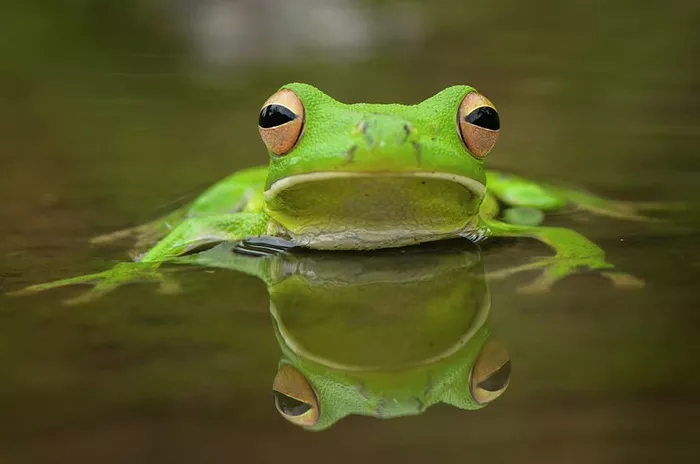
Many people wonder whether green tree frogs can swim. They often see these frogs resting on leaves, clinging to tree branches, or hiding near garden lights. Because they are called “tree frogs,” it is easy to assume they live only in trees. However, frogs are amphibians. This means they live part of their lives in water and part on land. So the question is simple but important: do green tree frogs swim?
The short answer is yes. Green tree frogs can swim. In fact, swimming is a natural and essential skill for them. But the full story is more interesting. Their swimming ability depends on their life stage, habitat, body structure, and environmental conditions. Understanding this helps owners, nature lovers, and students care for and observe these frogs correctly.
This article will explain in detail how and why green tree frogs swim. We will explore their anatomy, natural habitats, behavior in water, safety concerns, and differences between juveniles and adults. The goal is to provide clear, practical, and scientifically grounded information.
What Is a Green Tree Frog?
The green tree frog commonly refers to species such as the American Green Tree Frog (Hyla cinerea) and the Australian Green Tree Frog (Litoria caerulea). These frogs belong to the tree frog family, which is known for climbing ability and sticky toe pads.
Although they are commonly found in trees and shrubs, they are still amphibians. Amphibians are animals that begin life in water as larvae and later develop into land-dwelling adults. Because of this life cycle, water is essential to their survival.
Are Green Tree Frogs Natural Swimmers?
Yes, green tree frogs are natural swimmers. Swimming is not just a random behavior. It is built into their biology.
Frogs have long, powerful hind legs. These legs are designed for jumping, but they are also effective for swimming. Their feet are webbed, especially on the hind legs. Webbing increases surface area. This allows them to push against water more efficiently. When they kick, they generate forward movement.
Green tree frogs swim using a motion similar to a breaststroke. They stretch their hind legs outward and then pull them back in a strong, sweeping motion. This propels them forward smoothly.
Why Do Green Tree Frogs Swim?
1. Reproduction
One of the most important reasons green tree frogs enter water is breeding. Most green tree frogs lay eggs in water. The eggs hatch into tadpoles, which are fully aquatic. Tadpoles breathe through gills and must remain in water to survive.
Without water, reproduction would not be possible. Therefore, swimming is a necessary behavior during mating season.
2. Hydration and Skin Health
Frogs absorb water through their skin. They do not drink water the way mammals do. Their skin must remain moist to function properly. Sitting in shallow water helps them maintain hydration.
However, they do not always need deep water. Often, a shallow pool is enough.
3. Escape from Predators
Water can serve as a temporary escape route. If threatened, a green tree frog may jump into water to avoid a predator. Once underwater, it may remain still or swim to a safer location.
4. Temperature Regulation
Frogs are ectothermic. This means they rely on the environment to regulate body temperature. Water can help cool them during hot conditions.
How Well Do Green Tree Frogs Swim?
Green tree frogs are capable swimmers, but they are not built for long-distance swimming like aquatic frogs. Species such as bullfrogs spend much more time in water and are stronger swimmers.
Green tree frogs are semi-arboreal. They divide their time between vegetation and water sources. Their swimming is effective for short distances. They can move quickly and efficiently in ponds, marshes, or shallow containers.
Do Green Tree Frogs Like Deep Water?
Generally, green tree frogs prefer shallow water. Deep water can pose risks, especially in captivity. If a frog becomes exhausted and cannot easily climb out, drowning becomes a real danger.
In nature, ponds and wetlands often have gradual slopes. This allows frogs to move easily between land and water. In artificial environments, steep-sided containers can trap them.
Swimming Behavior in the Wild
In natural habitats, green tree frogs are often found near ponds, lakes, marshes, and slow-moving streams. They may sit on reeds above water and dive in when necessary.
They are not constantly swimming. Instead, they alternate between climbing and short periods in water. Their behavior is adaptive. They use water when it serves a purpose.
Swimming in Captivity
If you keep a green tree frog as a pet, you should provide a shallow water dish. The water must be clean and free from chlorine. Frogs absorb substances through their skin, so water quality is critical.
The water should be shallow enough for the frog to sit with its head above the surface. It should also be easy to exit. Smooth vertical walls should be avoided.
Can Green Tree Frogs Drown?
Yes. Although they can swim, green tree frogs can drown under certain conditions.
Drowning may occur if:
- The water is too deep.
- The frog is weak or sick.
- There is no easy way to climb out.
- The water temperature is too low.
Unlike fish, adult frogs breathe air with lungs. They must surface to breathe. If they cannot reach air, they will drown.
Differences Between Tadpoles and Adult Frogs
Tadpoles
Tadpoles are fully aquatic. They swim constantly. They use their tails for movement. At this stage, swimming is their only method of mobility.
Adult Frogs
Adult green tree frogs develop lungs and legs. Their tails disappear. They no longer depend entirely on water. Swimming becomes optional rather than mandatory.
Anatomy That Supports Swimming
Several anatomical features support swimming:
- Powerful hind legs
- Webbed feet
- Streamlined body
- Light skeletal structure
These traits allow efficient propulsion and buoyancy control.
Do Green Tree Frogs Swim at Night?
Green tree frogs are nocturnal. They are most active at night. If they enter water, it is usually during evening hours. Breeding activity also peaks at night, especially after rain.
Environmental Factors That Influence Swimming
Rainfall
Rain increases moisture and creates temporary pools. Frogs often become more active in water after heavy rain.
Temperature
Warm temperatures increase activity levels. Cold temperatures reduce movement and swimming behavior.
Habitat Type
Frogs living near wetlands swim more often than those in dry regions.
Common Misconceptions
Myth: Tree Frogs Never Enter Water
This is incorrect. Even tree-dwelling species require water for breeding and hydration.
Myth: All Frogs Are Strong Swimmers
Swimming ability varies by species. Some frogs are highly aquatic. Others, like green tree frogs, are moderate swimmers.
How to Observe Swimming Safely
If you want to observe a green tree frog swimming, do not force it into water. Allow natural behavior. Provide shallow, clean water and watch quietly.
Handling should be minimal. Oils and chemicals from human skin can harm frogs.
Conclusion
Green tree frogs can swim, and swimming is an essential part of their biology. They are not purely aquatic, but they are fully capable swimmers when necessary. Water supports their reproduction, hydration, and survival. However, they prefer shallow and accessible water rather than deep environments. Understanding their relationship with water helps ensure proper care and accurate observation. By recognizing their amphibian nature, we gain a clearer picture of how these fascinating animals live both in trees and in water.