
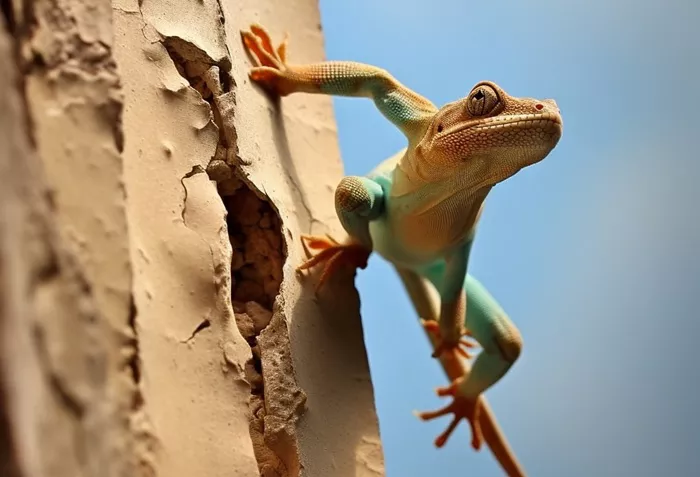
Lizards are fascinating reptiles that can often be seen climbing walls, ceilings, and other smooth surfaces with ease. This ability seems almost magical to humans. Many people wonder how these small creatures can defy gravity and remain attached to surfaces without falling. Understanding why lizards stick to walls requires a look at their anatomy, physical principles, and evolutionary advantages. In this article, we will explore these aspects in detail.
The Unique Anatomy of a Lizard’s Feet
Lizards have specialized feet that allow them to grip surfaces in ways other animals cannot. Their toes are equipped with tiny structures called setae. Setae are microscopic hair-like projections that cover the underside of a lizard’s toe pads. Each seta branches into even smaller structures called spatulae. These spatulae are so small that they interact with the molecules of surfaces at the atomic level.
The Role of Van der Waals Forces
The microscopic spatulae on a lizard’s toes generate adhesion through Van der Waals forces. These are weak intermolecular forces that occur between all molecules. Individually, Van der Waals forces are very weak, but when millions of spatulae contact a surface simultaneously, the combined effect is strong enough to support the lizard’s weight. This allows lizards to stick to walls and ceilings without any glue or suction.
How Surface Structure Affects Adhesion
The smoothness or roughness of a surface plays a role in a lizard’s ability to cling. Smooth surfaces, like glass or polished walls, allow more spatulae to make contact, providing maximum adhesion. Rough surfaces may reduce the number of contact points, but lizards can still manage to grip due to the flexibility and adaptability of their toe structures. Their toes can bend and conform to microscopic bumps and grooves, maintaining contact even on uneven surfaces.
Lizard Toe Movement and Locomotion
Lizards do not rely solely on static adhesion. They actively control their toe movements to maintain grip while moving. By adjusting the angle and pressure of their toes, they can attach and detach their feet rapidly as they climb. This dynamic movement allows lizards to run across walls and ceilings with remarkable speed and agility.
Self-Cleaning Mechanism
Lizards’ toes have a natural self-cleaning mechanism that helps them maintain adhesion. Dust and dirt can reduce the effectiveness of the Van der Waals forces. However, the flexible structure of setae and spatulae allows lizards to remove debris while walking or climbing. This ensures that their adhesion remains strong even in dusty or dirty environments.
Evolutionary Advantages of Wall-Climbing
The ability to stick to walls provides several evolutionary benefits. Climbing allows lizards to escape predators, hunt insects, and find safe resting places. Wall-climbing also enables them to access areas that other animals cannot reach, giving them a competitive advantage in their habitat. Over millions of years, natural selection has favored lizards with highly effective adhesive toe pads.
Different Types of Wall-Climbing Lizards
Not all lizards climb walls equally. Geckos are the most well-known climbers, but other species, such as anoles and some skinks, also have adhesive abilities. Each species has variations in toe pad structure, which affect how they stick to surfaces. For example, some geckos have extremely fine spatulae, allowing them to climb smooth glass, while others prefer rougher surfaces in their natural environment.
The Physics Behind Lizard Adhesion
Lizard adhesion is a combination of biology and physics. The large number of contact points between spatulae and surfaces generates a force strong enough to support their weight. Additionally, the angle and flexibility of the toes allow lizards to distribute forces evenly, preventing slips. Scientists study these principles to develop new materials and technologies inspired by lizard adhesion, such as wall-climbing robots and advanced adhesives.
Myths and Misconceptions
There are many myths about how lizards stick to walls. Some believe they use sticky secretions or suction cups, but these are not true. The real mechanism is purely physical and based on microscopic structures and intermolecular forces. Understanding the science behind it helps dispel these misconceptions and highlights the marvel of natural evolution.
Applications in Human Technology
Scientists have studied lizard adhesion to develop synthetic materials that mimic their toe pads. These materials, called gecko-inspired adhesives, can stick to surfaces without glue and can be reused multiple times. Applications include climbing robots, medical adhesives, and industrial tools. By studying lizards, humans can create innovative solutions that replicate nature’s efficiency.
Environmental Factors Affecting Adhesion
Lizards’ ability to stick to surfaces can be influenced by temperature, humidity, and surface cleanliness. High humidity can enhance adhesion by increasing surface interactions, while extreme heat may reduce the effectiveness of toe pad contact. Understanding these factors is important for both studying lizards in the wild and designing bio-inspired materials.
Behavioral Aspects of Wall-Climbing
Lizards often choose climbing routes strategically. They may prefer walls that are close to shelter or where insects are abundant. Climbing behavior is not random; it is influenced by survival needs, hunting strategies, and escape from threats. Observing lizards in their natural habitat provides insights into the practical advantages of their climbing abilities.
Conclusion
Lizards stick to walls thanks to a combination of specialized anatomy, physics, and evolutionary adaptation. Tiny structures on their toes generate Van der Waals forces, allowing them to cling to surfaces without glue or suction. Their ability to move dynamically, maintain clean toe pads, and adapt to different surfaces ensures their survival in diverse environments. Beyond their fascinating biology, lizards inspire technology and innovation, proving that nature often provides solutions that humans can learn from. Understanding how lizards stick to walls deepens our appreciation of these remarkable reptiles and the intricate mechanisms that make life possible in extraordinary ways.
Related Topics: