
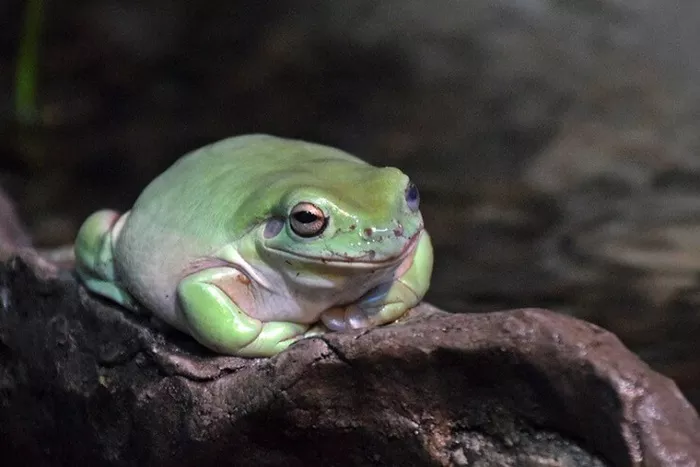
White’s Tree Frogs (Litoria caerulea), also known as Dumpy Tree Frogs or Australian Green Tree Frogs, are one of the most popular amphibians kept as exotic pets. Known for their vibrant green-blue color and chubby appearance, they have fascinated both herpetologists and pet enthusiasts alike. But beyond their appearance and low-maintenance care needs, questions often arise about their social behavior.
One of the most important questions is: Are White’s Tree Frogs solitary? In other words, do they prefer to live alone, or do they thrive better when housed with other frogs?
To answer this, we must explore their behavior in the wild, how they interact in captivity, and what environmental and biological factors influence their social habits. This article will guide you through the complete behavioral profile of White’s Tree Frogs, especially focusing on their social tendencies, to determine whether these amphibians are truly solitary or if they enjoy the company of others.
Understanding the Natural Habitat
White’s Tree Frogs are native to Australia, Indonesia, and Papua New Guinea. In their natural range, they are typically found in warm, humid environments such as rainforests, woodlands, and even suburban areas. They are arboreal, meaning they spend most of their lives in trees or elevated areas.
This environment plays a crucial role in shaping their behavior. Trees provide hiding places, food sources, and protection from predators. Unlike animals that depend on packs or groups for survival, tree-dwelling creatures often benefit from living alone. The abundance of vertical space allows them to establish individual territories without needing to compete constantly for horizontal land space.
Therefore, the habitat itself suggests a degree of independence. This does not conclusively prove that White’s Tree Frogs are solitary, but it sets the stage for further investigation.
Solitary Versus Social Animals: Definitions
To properly classify the social behavior of White’s Tree Frogs, we must first define what it means to be solitary or social in zoological terms.
Solitary animals live most of their lives alone. They do not require the presence of others of their species to function normally. They may come together only for mating or specific environmental needs.
Social animals, on the other hand, thrive on interaction. They may live in groups or pairs and exhibit cooperative behavior like shared hunting or grooming.
These definitions are crucial because many animals exhibit behavior that lies somewhere in between. Some species may tolerate conspecifics (members of their own species) but do not seek them out. Others may live alone for long periods but become temporarily social during breeding seasons.
Where do White’s Tree Frogs fall on this spectrum?
Wild Behavior Observations
In the wild, White’s Tree Frogs are mostly seen alone. Field studies conducted in northern Australia and Papua New Guinea have shown that individuals often perch separately, even when multiple frogs are found in the same general area.
They do not appear to form groups, family units, or cooperative associations. Instead, they occupy loosely defined territories, usually based on access to food, water, and shelter. These territories are not defended aggressively, but frogs will move to avoid close contact with others.
However, during the rainy season, things change slightly. As temporary pools form, male frogs gather in the vicinity and call out to attract females. This behavior may give the impression of sociality, but it is short-lived and strictly linked to reproduction.
The fact that White’s Tree Frogs gather temporarily for breeding but disperse afterward supports the idea that they are facultatively solitary—not strictly antisocial, but not naturally group-living either.
Captive Behavior and Pet Settings
In captivity, White’s Tree Frogs are often housed in groups. Some people keep two or more in a single terrarium, often because of limited space or the desire to create a more naturalistic environment. But how do these frogs respond?
White’s Tree Frogs show a high degree of tolerance toward conspecifics in captivity. They do not fight frequently, and they rarely show aggressive behavior, even when housed in close quarters. However, they also do not engage in bonding activities or communal behaviors.
In other words, they may not mind being around other frogs, but they do not seek social contact. Each frog maintains its own personal space. They may sit close together on a branch or near the water dish, but this proximity is more a result of environmental structure than social preference.
Moreover, observations suggest that the more space available, the more the frogs tend to spread out. This supports the idea that they are only superficially social—tolerant of others but not emotionally or biologically inclined toward companionship.
Is Group Housing Stressful?
Though White’s Tree Frogs are tolerant, that does not mean group housing is always beneficial.
Amphibians can experience stress in captivity, often in subtle ways. Chronic stress can suppress appetite, lower immunity, and make them more susceptible to disease. In shared environments, competition for food, basking spots, or hiding areas can result in stress, even if it does not lead to visible conflict.
For example, a larger or more dominant frog may outcompete a smaller one during feeding times. Since amphibians are not overtly aggressive like some reptiles or mammals, this dominance may go unnoticed by owners.
Additionally, cohabitation increases the chance of disease transmission. One sick frog can infect others quickly due to the shared humidity and surfaces. For this reason, many experienced herpetologists recommend quarantining new frogs before introducing them to a shared enclosure.
Thus, even though group housing is possible, it is not always ideal. Frogs may tolerate each other, but that does not mean they thrive best in groups.
Breeding Behavior and Temporary Socialization
White’s Tree Frogs exhibit seasonal breeding, often triggered by environmental cues such as increased rainfall and temperature. During this period, males vocalize extensively to attract females.
This vocalization leads to temporary group formation, usually around water sources. Males may cluster together, each trying to out-call the others. Females visit the site, choose a mate, and then leave after laying eggs.
This behavior demonstrates that temporary social interactions occur, but only for reproductive purposes. There is no indication of long-term bonding between mating pairs or parental care after eggs are laid.
In short, White’s Tree Frogs can become social when necessary, but they do not form permanent or stable social structures. This supports the view that they are solitary by nature with temporary exceptions.
Cognitive and Emotional Capacity for Social Bonds
One reason mammals form strong social bonds is due to their advanced neurological structures, especially those related to emotional processing. Frogs, being amphibians, do not possess the same level of neural complexity.
White’s Tree Frogs have excellent vision, hearing, and motor skills. They are intelligent in terms of environmental interaction and problem-solving. However, their brains do not support complex emotional bonding the way mammals do.
There is no evidence to suggest that they form attachments to tank mates or “miss” companions when separated. Their behavior is largely instinctual, not emotionally driven.
This further supports the classification of these frogs as solitary creatures—not in a negative sense, but simply due to their evolutionary design.
Should You Keep a Single White’s Tree Frog?
For pet owners, the question becomes practical: Is it better to keep one frog or multiple?
Given their solitary tendencies, it is perfectly natural—and often preferable—to keep just one frog per enclosure. A single frog does not feel lonely. As long as its environmental needs are met, it will thrive.
If you do choose to keep multiple frogs, it is important to provide a large enough tank, multiple hiding spots, and ample food. Avoid mixing frogs of significantly different sizes, and watch for signs of stress or weight loss.
Ultimately, keeping a White’s Tree Frog alone is not cruel. It often results in better health, reduced stress, and easier management.
What About Interacting with Other Species?
White’s Tree Frogs should not be housed with other amphibians or reptiles. While they are not aggressive, they may try to eat smaller animals, and they can be injured by larger ones.
Different species have different environmental needs, and mixing them often results in compromised care for both. Furthermore, cross-species disease transmission is a serious concern.
In short, White’s Tree Frogs do best alone—or, if desired, with other frogs of the same species and similar size in a carefully managed environment.
Conclusion:
Yes, White’s Tree Frogs are solitary by nature. They do not form social groups in the wild, and while they tolerate other frogs in captivity, they do not require or seek social interaction.
Their natural habitat, breeding patterns, cognitive limitations, and behavior all point toward a solitary lifestyle. Temporary associations during mating or in shared spaces do not equate to true social living.
For pet owners and enthusiasts, this means that keeping a single White’s Tree Frog is not only acceptable—it may be the best way to ensure the frog’s well-being.
Related topics: