
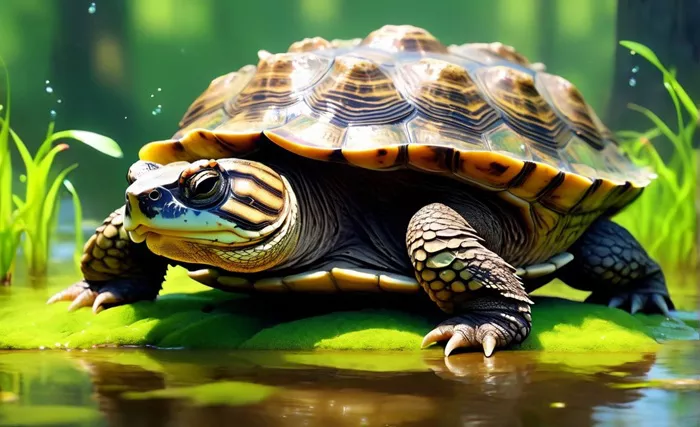
Have you ever wondered about the inner workings of the creatures you see in the wild? If you’ve ever crossed paths with a snapping turtle, you might have admired its powerful jaws or its prehistoric look. But have you ever wondered about its internal structure? Specifically, does a snapping turtle have a dorsal nerve cord?
In this article, we’ll delve into this fascinating question and explore the wonders of the snapping turtle’s anatomy. We’ll break it down in simple terms, use relatable analogies, and ensure that even if you’re new to the subject of reptiles, you’ll get a clear picture. You’ll not only learn about the dorsal nerve cord but also uncover many other exciting facts about this unique creature’s anatomy. So, let’s dive in!
What Is a Dorsal Nerve Cord?
Before we go straight into whether the snapping turtle has one, let’s first understand what the dorsal nerve cord is. Imagine the nervous system as a network of electrical wiring running through your body. The dorsal nerve cord is like the main cable that connects all the signals between your brain and body.
In many animals, including humans, this structure is crucial for sending messages to different parts of the body. It’s located on the back (hence “dorsal”) and runs along the spine, protected by the vertebral column.
In simple terms: Think of it like the central internet cable in your home. If it’s intact, all your devices (or in this case, your body parts) can communicate properly. If it’s broken, communication is disrupted.
Now, with this understanding in place, let’s figure out if snapping turtles share this feature.
Snapping Turtles: A Quick Overview
Snapping turtles are one of the most recognizable species in the reptile world. They belong to the family Chelydridae and are known for their aggressive behavior and their large, powerful heads. These turtles can be found in freshwater habitats across North America, from ponds and rivers to lakes and swamps.
But their most distinct feature, beyond their appearance, is their long lifespan, often reaching up to 40 years or more in the wild. That’s a lot of time for a dorsal nerve cord to play an essential role in its survival!
Do Snapping Turtles Have a Dorsal Nerve Cord?
The simple answer is: Yes, snapping turtles do have a dorsal nerve cord. But before you think this is a straightforward conclusion, let’s dive deeper into why this is the case.
Like all vertebrates, snapping turtles belong to a group of animals that have a backbone, known as chordates. The dorsal nerve cord is one of the three key features of chordates, along with the notochord and pharyngeal gill slits (don’t worry if that sounds complicated – we’ll get to that in a bit).
The dorsal nerve cord, in particular, runs along the back of the turtle and is essential for its survival. It connects the brain to the rest of the body, allowing the snapping turtle to react quickly to its environment, which is especially important when it comes to hunting and protecting itself.
To put it in perspective, imagine if you couldn’t feel anything below your neck. You wouldn’t be able to move properly or react to the world around you. The dorsal nerve cord is essential for all of that – it ensures the turtle’s body stays in sync with its brain.
The Role of the Dorsal Nerve Cord in Snapping Turtles
Now that we know the snapping turtle has a dorsal nerve cord, let’s explore its role in the animal’s daily life.
Motor Control and Reflexes
The dorsal nerve cord is a vital part of the turtle’s nervous system. It carries signals from the brain to the muscles, allowing the turtle to perform movements like swimming and walking. Even in situations where the turtle’s life is threatened, the dorsal nerve cord enables quick reflexes, like when the turtle snaps at a potential threat.
Sensory Perception
The dorsal nerve cord also helps the snapping turtle to process sensory information. From detecting changes in the water’s temperature to responding to the vibrations caused by a predator, this nerve cord plays a key role in how the turtle perceives its surroundings.
Coordination of the Body
The coordination between the front and back parts of the snapping turtle’s body relies heavily on the dorsal nerve cord. When swimming or moving on land, signals travel down the cord to the muscles, ensuring that the turtle’s movements are smooth and coordinated.
Survival Mechanism
Snapping turtles are opportunistic predators, and their survival depends on their ability to act quickly. The dorsal nerve cord allows for lightning-fast responses. Whether it’s catching prey, avoiding predators, or defending itself, the dorsal nerve cord ensures that the turtle’s body is always ready for action.
How Does the Dorsal Nerve Cord Compare to Other Animals?
You might be curious – does every animal have a dorsal nerve cord? The answer is no. While most vertebrates, including birds, mammals, and reptiles, have a dorsal nerve cord, invertebrates such as insects and jellyfish don’t possess one. Instead, they may have a ventral nerve cord (located along the belly side of their body).
Here’s an easy way to remember: If an animal has a backbone or spine, it likely has a dorsal nerve cord. Think of it as a hallmark feature of vertebrates. Whether it’s a fish, bird, or turtle, the dorsal nerve cord is an essential part of their anatomy, ensuring they can move, sense, and survive in their environment.
Dorsal Nerve Cord in Other Reptiles
Since we’re talking about reptiles, it’s worth mentioning how the dorsal nerve cord functions in other species within this group. Reptiles like lizards, snakes, and crocodiles also possess a dorsal nerve cord. Just like the snapping turtle, their nervous systems rely on this structure to perform crucial life functions, including movement and sensory perception.
For example, snakes rely heavily on their dorsal nerve cord for coordination when hunting or escaping predators. The same goes for lizards, which use their dorsal nerve cord to help them run at high speeds to avoid danger. It’s a common feature among reptiles, which makes sense since they share similar evolutionary ancestors.
Fun Fact: The Evolution of the Dorsal Nerve Cord
Did you know that the dorsal nerve cord is an ancient feature that dates back over 500 million years? It’s part of the evolutionary legacy of chordates, the group of animals that includes fish, amphibians, reptiles, birds, and mammals. Over time, this structure evolved to meet the needs of different species, whether for swimming in the ocean or running on land.
The presence of a dorsal nerve cord in the snapping turtle, and its importance in survival, highlights just how fundamental this structure is to the way animals function.
Conclusion
The dorsal nerve cord is more than just a simple anatomical feature – it’s the lifeline that helps snapping turtles thrive in their environment. From reflexes and movement to sensory perception and survival, this structure is essential for everything the turtle does. Understanding it helps us appreciate the intricate ways in which the natural world operates, and it reminds us how amazing and complex even the simplest creatures can be.
By the way, next time you see a snapping turtle, you’ll be able to imagine all the processes happening inside its body that help it function – all thanks to its dorsal nerve cord.
Related topics: