
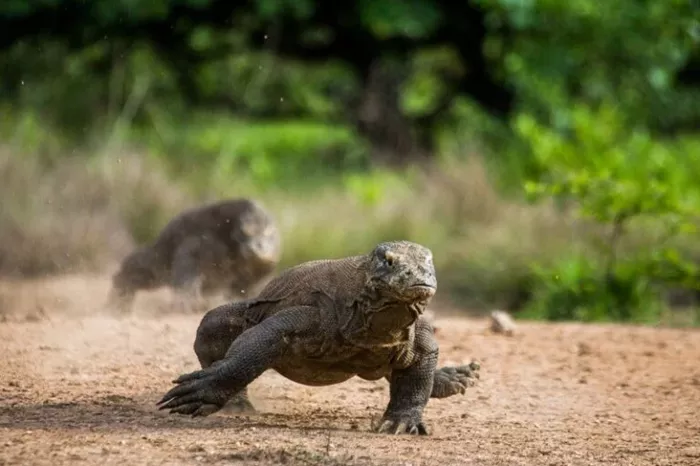
You’re walking through a tropical island, sun beating down, everything quiet—until a massive, lizard-like creature locks eyes with you. Your heart races. Can you outrun it? Should you even try?
That creature might be a Komodo dragon, the largest living lizard on Earth, and one of the most mysterious predators known to science. You may have heard wild stories: it’s venomous, it’s fast, and it can bring down prey many times its size. But how does it compare to you, an average human, in a footrace?
In this article, we’ll explore that question in detail, breaking down how fast Komodo dragons can move, how humans compare, and—perhaps most importantly—what your chances are if you ever find yourself face-to-face with one.
Brace yourself. Some of the facts may surprise you.
Understanding the Komodo Dragon: A Brief Overview
Before we jump straight into speed comparisons, it helps to understand what makes the Komodo dragon (Varanus komodoensis) such a fascinating (and terrifying) animal.
This reptile can grow up to 10 feet long and weigh over 150 pounds. It’s native to just a few Indonesian islands, including Komodo, Rinca, Flores, and Gili Motang. Because of its limited range and apex status in its ecosystem, it’s often referred to as a living dinosaur.
But its appearance is just the beginning. What sets it apart is its stealth, power, and shocking speed.
How Fast Can a Komodo Dragon Run?
Let’s get to the heart of the matter.
Despite their bulky bodies and heavy tails, Komodo dragons are surprisingly fast. In short bursts, they can sprint at speeds of up to 13 to 15 miles per hour (21 to 24 kilometers per hour).
To put that in perspective: imagine a school bus. Now imagine that bus coming at you with sharp teeth, claws, and zero fear.
Most adult Komodo dragons don’t run constantly. They save their energy for explosive chases, especially during ambush attacks on prey such as deer, wild boars, or even water buffalo. They rely on a short-range burst to catch their victims off guard.
Still, 15 mph is no joke—especially from a creature you didn’t expect to move that fast.
How Fast Can a Human Run?
Now let’s look at you. Can you outrun one?
The average human jogging speed is about 4 to 6 mph (6 to 10 km/h). That’s a relaxed run—something you might do on a treadmill.
But let’s say you’re suddenly very motivated. In moments of panic, adrenaline kicks in and your body can do amazing things. Average sprint speed for a healthy adult is around 12 to 15 mph (19 to 24 km/h).
If you’re an athlete or a particularly fast sprinter, you might push it up to 20 mph (32 km/h) or more. For reference, Usain Bolt, the world’s fastest sprinter, clocked in at 27.8 mph (44.7 km/h) at his peak.
So yes, a fast human can outrun a Komodo dragon—but only for a short distance and under ideal conditions.
Where Do You Stand in This Race?
Here’s the catch: most of us aren’t Usain Bolt. Most of us are somewhere between a brisk jog and a panicked dash. And if you’re on uneven terrain, in hot weather, or shocked by the sudden appearance of a predator, you’re probably not running your personal best.
Let’s paint a realistic picture.
Imagine you’re hiking through Komodo National Park. The path is rocky and steep. You’re carrying water and maybe a backpack. Then—bam!—a Komodo dragon spots you and bolts forward at 13 mph.
Do you have time to react? Can you even turn fast enough?
In a flat-out race, an average human and a Komodo dragon might be evenly matched for a few seconds. But remember: you have endurance, and they have bursts. Dragons sprint briefly and then stop. You might just outlast it, if you can stay ahead and avoid tripping.
Why Komodo Dragons Rarely Chase Humans
Good news: they’re not in the habit of chasing people.
Komodo dragons are ambush predators. They prefer to lie in wait, hidden among shrubs or rocks. They’re patient and cunning, often waiting hours for the right moment to strike. When they do attack, it’s typically because they feel threatened or are hunting easy prey.
Humans are not their usual food source. While attacks have occurred, they’re rare. Most happen when someone gets too close or startles the dragon—for example, a tourist trying to snap a selfie.
Still, they are dangerous. Their mouths are full of toxic bacteria and venom, and a single bite can lead to infection, blood loss, and even death if not treated properly.
So while outrunning a Komodo dragon is theoretically possible, the smarter strategy is not to run—but to avoid provoking it in the first place.
What Should You Do If You Encounter One?
Let’s get practical.
Here’s what experts (and park rangers) recommend if you come face-to-face with a Komodo dragon:
Stay calm. Sudden movements might trigger its hunting instincts.
Do not turn your back. Keep facing the dragon and slowly back away.
Find higher ground or a barrier. Komodo dragons can’t climb well as adults.
Use an object to protect yourself. A stick, bag, or jacket can be used as a buffer.
Don’t run unless you’re sure you can make it. Sudden fleeing might encourage a chase.
Park guides are always present in Komodo National Park for this reason. They carry sticks to fend off curious dragons and help keep tourists safe.
Strength vs. Speed: Why It’s Not Just About Running
Speed alone doesn’t determine survival. Komodo dragons are strong, patient, and stealthy. They often rely on their bite and venom rather than a long chase.
Once bitten, prey animals may escape temporarily—but they’re often tracked by the dragon’s incredible sense of smell. A Komodo can follow a wounded animal for miles using its forked tongue, which picks up scent particles in the air.
Think of it like a detective dog with scales. Running might help you in the moment, but escaping unharmed is the real victory.
Real Stories: Humans vs. Komodo Dragons
There have been recorded cases of Komodo dragon attacks on humans. One famous incident happened in 2009 when a man was killed after entering a restricted area. In 2017, a tourist was bitten while taking photos too close.
In each case, the key mistake was getting too close without understanding the risks.
Still, these events are rare. Most visits to Komodo National Park are safe, and thousands of people see these animals every year without incident—thanks to careful guidelines and trained guides.
Comparing Anatomy: Built for Power, Not Marathons
Let’s break down why Komodo dragons are burst runners, not marathoners.
Their muscles are designed for quick, short movements. Their legs are thick and powerful, giving them a fast launch but tiring them quickly. They also carry heavy tails, which help with balance but slow them down over time.
Humans, on the other hand, evolved to run long distances. Compared to most animals, we have exceptional stamina, even if we lack explosive speed.
In essence, the Komodo is the sprinter. You’re the long-distance runner.
So if the chase lasts more than 30 seconds, your chances start to improve.
A Fun Analogy: The Dragon and the Treadmill
Think of the Komodo dragon like a treadmill set to sprint speed—say 13 mph—but it only runs for 10 seconds before shutting off. Now imagine you, the human, at a solid 9 mph, but able to go for a couple of minutes.
If you can dodge the initial burst, stay on your feet, and keep moving—you win.
What About Climbing or Swimming?
You might think: “Can I climb a tree or dive into water to escape?”
Tree? Not ideal. Juvenile Komodo dragons can climb trees very well. Adults are less capable due to their weight, but they can still reach you if you’re low.
Water? Be careful. Komodo dragons are surprisingly good swimmers. They can cross between islands and travel several hundred meters in the water. Swimming away may not help, especially if you’re tired or panicking.
Instead, the safest route is to follow your guide, stay in open areas, and never provoke the dragon.
Why This Question Matters
It might seem like a wild, even funny question—can you outrun a Komodo dragon? But it’s important because it sparks curiosity and reveals real truths about how we coexist with dangerous animals.
It also reminds us that being informed is the first step to staying safe.
Wild animals aren’t villains. They’re just doing what nature programmed them to do. Respecting their space—and understanding their limits—helps us protect both humans and wildlife.
Conclusion
So, can a human outrun a Komodo dragon?
Yes—but with a big asterisk.
You’d need to be alert, in shape, and have the right terrain. In short bursts, dragons can match or even exceed your speed. But they can’t maintain it for long. If you stay calm, make smart choices, and avoid triggering a chase in the first place, you’ll probably never need to test your sprinting skills.
Nature’s rules are simple: respect, observe, and prepare. Do that, and you’ll stay safe—and marvel at one of the planet’s most incredible reptiles.
Related topics: