
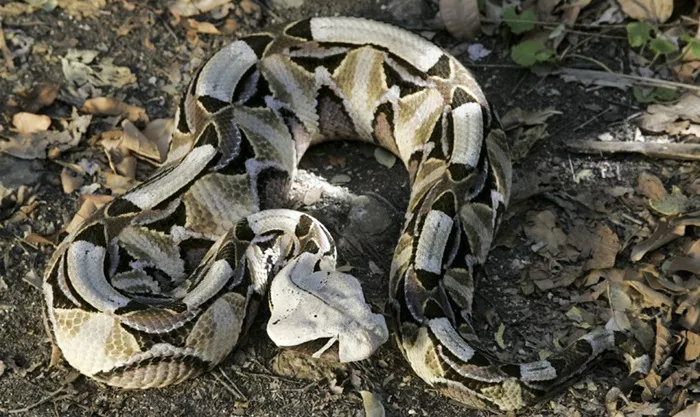
The Gaboon viper (Bitis gabonica) is one of the most impressive and enigmatic snakes found in the rainforests and savannas of sub-Saharan Africa. With its striking coloration, broad triangular head, and heavy body, this snake has earned a reputation for being both beautiful and dangerous. But when people ask, “Are Gaboon vipers poisonous?”, they are often using the wrong term.
In zoological science, the term “poisonous” refers to organisms that release toxins when touched or eaten. In contrast, “venomous” animals inject toxins through a bite or sting. The Gaboon viper falls into the latter category. It is not poisonous, but it is highly venomous.
This article explores in detail the nature of the Gaboon viper’s venom, how it is delivered, its effects on prey and humans, and its ecological role. We will also look at myths and misunderstandings surrounding this fascinating snake, and why understanding its biology is important for both public safety and conservation efforts.
What Is the Difference Between Poisonous and Venomous?
Before we examine the Gaboon viper specifically, it’s important to clarify terminology. Many people use the words “poisonous” and “venomous” interchangeably, but they have different meanings in biology.
Poisonous animals release toxins when they are touched, eaten, or otherwise interacted with. A good example is the poison dart frog, whose skin secretes toxins.
Venomous animals inject toxins directly into another animal, usually through fangs, stingers, or other specialized organs. Snakes, scorpions, and spiders fall into this category.
The Gaboon viper is venomous. It uses long, hinged fangs to deliver venom deep into its prey. These fangs are the longest of any known snake, measuring up to 5 centimeters (about 2 inches) in length.
Venom Composition of the Gaboon Viper
The venom of the Gaboon viper is complex and potent. It contains several types of toxic proteins, each with different effects on the body. These include:
Hemotoxins: These toxins destroy red blood cells and cause tissue damage. They break down blood vessels, leading to internal bleeding.
Cytotoxins: These damage or kill cells directly, especially at the bite site.
Neurotoxins (in small amounts): These affect the nervous system, although the Gaboon viper’s venom is not primarily neurotoxic.
The combination of these toxins makes the Gaboon viper’s venom extremely effective at immobilizing and killing its prey quickly. Unlike some snakes that rely heavily on chasing or constricting prey, the Gaboon viper can strike once and let its venom do the rest.
How the Gaboon Viper Delivers Its Venom
Gaboon vipers have a unique venom delivery system. Their fangs are not only the longest of any venomous snake, but also extremely sharp and curved. This allows them to inject venom deeply and efficiently.
When the snake bites, its mouth opens up to nearly 180 degrees. The long fangs then swing forward into position. Because of this anatomy, the Gaboon viper can inject a large amount of venom in a single bite—up to 240 milligrams, and possibly more in large individuals.
This quantity is more than enough to kill a human if left untreated, although bites to humans are extremely rare. Gaboon vipers are known for their calm and docile nature. They rarely strike unless they are stepped on or provoked.
Effects of a Gaboon Viper Bite
The effects of a bite from a Gaboon viper can be severe and potentially fatal without medical treatment. The venom causes widespread tissue damage, intense pain, and systemic effects that can affect the heart, kidneys, and blood circulation.
Local Symptoms:
−Intense pain at the site of the bite
−Swelling and bruising
−Tissue necrosis (death of tissue)
−Blistering and bleeding
Systemic Symptoms:
−Internal bleeding
−Low blood pressure
−Organ failure (especially kidneys)
−Shock
−In rare cases, death
Because the venom causes tissue breakdown and bleeding, victims can experience severe complications even if the bite is not immediately fatal. In some cases, amputation of the affected limb may be required.
Fortunately, antivenom exists and can be used to treat bites if administered quickly. Supportive care in a hospital setting is also critical for recovery.
Are Gaboon Vipers a Threat to Humans?
Although the Gaboon viper is highly venomous, it is not considered a major threat to humans. This is mainly due to its behavior and habitat.
Behavioral Traits
Gaboon vipers are generally shy and non-aggressive. They are ambush predators and spend most of their time hidden under leaf litter or vegetation, waiting for prey to pass by. They do not chase or actively hunt humans.
When threatened, they may hiss loudly as a warning, but they rarely strike unless stepped on or cornered. Most documented bites to humans happen when people accidentally step on them in the wild or try to handle them without proper precautions.
Habitat and Distribution
Gaboon vipers are native to tropical forests and savannas in Central, West, and parts of East Africa. They prefer areas with dense vegetation and plenty of ground cover. Human encounters are rare, especially in remote forested regions.
Still, their camouflage makes them difficult to spot, increasing the risk of accidental encounters in areas where humans and vipers share the same habitat.
Ecological Role of the Gaboon Viper
Gaboon vipers play an important role in their ecosystems. As top ambush predators, they help regulate populations of small mammals, birds, and amphibians. This natural control prevents overpopulation of rodents and other small animals that could damage crops or spread disease.
In turn, the viper may be preyed upon by large birds of prey or carnivorous mammals, especially when it is young or injured. However, adult Gaboon vipers have few natural enemies due to their size and potent venom.
By maintaining ecological balance, Gaboon vipers contribute to the overall health of their environment. Protecting them also protects the biodiversity of the forests they inhabit.
Medical and Scientific Importance
Gaboon viper venom has been studied for its potential use in medicine. Scientists are exploring its components for possible applications in drug development, especially in areas related to blood clotting, cardiovascular function, and cancer research.
For example, some enzymes in the venom can affect blood pressure and coagulation. Understanding how these enzymes work may help researchers develop new treatments for stroke, heart disease, or even tumors.
However, working with venom requires caution and expert handling. Research is ongoing, and much is still unknown about the full potential of Gaboon viper venom in human medicine.
Misconceptions and Myths
There are many myths and misconceptions about Gaboon vipers. Some believe they chase humans or can jump long distances. Others think their venom is instantly fatal. While their venom is powerful, many of these beliefs are exaggerated.
Common Myths
Myth: Gaboon vipers are aggressive.
Fact: They are one of the most docile vipers and prefer to remain still or flee.
Myth: They can leap at prey or people.
Fact: They strike quickly but do not jump. Their body structure is not built for leaping.
Myth: There is no cure for their bite.
Fact: Antivenom exists, and with prompt medical care, survival is likely.
Clearing up these myths helps people understand the true nature of these snakes and promotes a more informed and respectful relationship with wildlife.
Conclusion
So, are Gaboon vipers poiso
nous? No, they are not poisonous—they are venomous. This is an important distinction. Their venom is powerful and can be deadly, but they are not dangerous unless provoked or mishandled. In fact, Gaboon vipers are quiet, secretive animals that pose little threat to humans in their natural environment.
Understanding their biology, behavior, and ecological role helps reduce fear and promotes coexistence. Whether encountered in the wild or studied in scientific research, the Gaboon viper is a fascinating example of evolution’s power and precision.
By respecting these animals and protecting their habitats, we ensure that future generations can continue to learn from and appreciate one of Africa’s most remarkable snakes.
Related topics: