
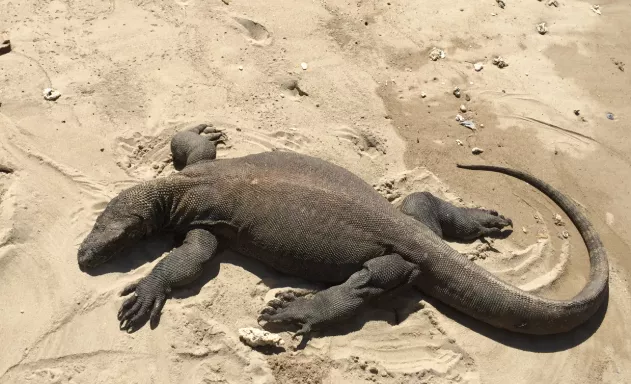
The Komodo dragon is one of the most fascinating and mysterious creatures on Earth. This enormous reptile, found only on a few islands in Indonesia, has sparked curiosity for centuries. But who first discovered this ancient species? In this article, we will explore the history of the Komodo dragon’s discovery, the explorers involved, and how it became an iconic animal of the natural world.
Introduction to the Komodo Dragon
The Komodo dragon, scientifically known as Varanus komodoensis, is the largest living species of lizard. It can grow up to 10 feet in length and weigh over 150 pounds. These incredible creatures are native to the islands of Komodo, Rinca, Flores, and Gili Motang in Indonesia. Despite their fearsome reputation, they are an important part of the ecosystem and have become a symbol of Indonesia’s unique biodiversity.
The First Encounters with the Komodo Dragon
For centuries, the Komodo dragon was a myth. Local people spoke of giant lizards, but no one outside the region had ever seen one. It wasn’t until the early 20th century that the Western world first learned about the existence of this remarkable creature.
Early Accounts and Local Legends
Local islanders had known about the Komodo dragon for centuries. They referred to it as the “ora,” a word that means “dragon” in the local language. The dragon was often a subject of local folklore, with stories of the creature’s enormous size and fierce nature being passed down through generations.
While these legends were intriguing, there was no concrete evidence that these creatures existed outside of local myths. This all changed when a Dutch colonial officer named Willem Beijerinck made a groundbreaking discovery in 1910.
Willem Beijerinck and the Dutch Expedition
In 1910, Willem Beijerinck, a Dutch colonial official stationed in the East Indies, heard rumors of a large, dangerous lizard living on the islands of Komodo and Rinca. Intrigued by these reports, Beijerinck organized an expedition to investigate further. He was determined to find out if the creature mentioned in local legends was real.
Beijerinck’s team visited the island of Komodo, where they discovered the giant lizards that had long been rumored to exist. Beijerinck described the creatures as “dragons,” and this name stuck. He sent a specimen back to the Netherlands for scientific examination. The specimen was identified as a new species of lizard, and thus, the Komodo dragon was formally introduced to the world.
Scientific Recognition of the Komodo Dragon
The discovery of the Komodo dragon by Beijerinck sparked a wave of scientific interest. Zoologists and biologists were fascinated by the size, behavior, and unique characteristics of the creature. However, it wasn’t until 1912 that the Komodo dragon was formally classified as a new species by Dutch scientist J.A. Steyn.
Steyn’s classification of the Komodo dragon as Varanus komodoensis was based on Beijerinck’s specimen and the additional research conducted by other scientists. This marked the official recognition of the Komodo dragon as a distinct species and brought global attention to its existence.
Other Explorers and Naturalists Involved in the Discovery
While Beijerinck’s expedition was the first to document the Komodo dragon, other explorers and naturalists played a crucial role in learning more about the species. One of the most notable figures in the study of the Komodo dragon was the American naturalist and explorer Dr. Walter W. J. Johnstone.
In the 1920s, Johnstone made several trips to the islands of Komodo and Rinca, studying the Komodo dragons in their natural habitat. His work helped deepen the scientific community’s understanding of the animal’s behavior, diet, and physiology. Johnstone’s contributions were instrumental in bringing the Komodo dragon to international attention and securing its place in the annals of zoological history.
The Komodo Dragon in Modern Science
Since the initial discovery of the Komodo dragon, scientific research on the species has expanded significantly. In the decades following its discovery, scientists have studied various aspects of the Komodo dragon, from its hunting techniques to its unique immune system. Researchers have discovered that the Komodo dragon’s bite is venomous, and it uses a combination of bacteria and toxins to incapacitate its prey.
Today, the Komodo dragon is a subject of ongoing research, with biologists studying its behavior, genetics, and conservation status. The species is currently listed as vulnerable by the International Union for Conservation of Nature (IUCN), with habitat loss and climate change posing significant threats to its survival.
Conservation Efforts and the Future of the Komodo Dragon
As the Komodo dragon continues to capture the imagination of people around the world, efforts to protect the species have become increasingly important. Indonesia has established the Komodo National Park, a protected area that covers the islands where the Komodo dragon lives. This park helps to preserve the creature’s natural habitat and provides a safe environment for the species to thrive.
In addition to the national park, various conservation organizations are working to raise awareness about the threats facing the Komodo dragon and to promote sustainable tourism practices. The goal is to ensure that future generations will be able to witness the awe-inspiring Komodo dragon in its natural environment.
Conclusion
The discovery of the Komodo dragon is a remarkable story of exploration, curiosity, and scientific achievement. From the early reports of local islanders to the groundbreaking expedition of Willem Beijerinck, the journey to uncover this incredible species is one that has fascinated people around the world. Today, the Komodo dragon continues to be a symbol of Indonesia’s rich natural heritage and a subject of ongoing research and conservation efforts.
Related topics