
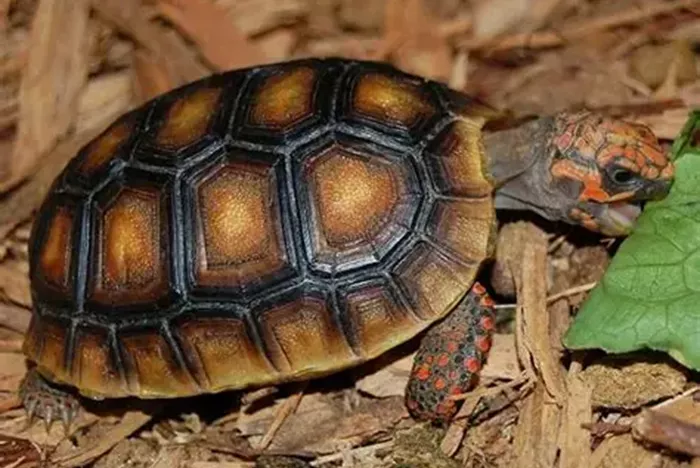
When you think of a tortoise, what comes to mind? A slow-moving animal that quietly munches on leaves, barely noticing the world? That’s the common image. But red-footed tortoises (Chelonoidis carbonaria) are breaking this stereotype. These medium-sized reptiles from Central and South America are not only visually striking, with their red or orange markings on legs and head, but they also have brains that can surprise even experienced reptile enthusiasts.
You might ask, “Tortoises can be smart? How smart?” Well, recent studies show that red-footed tortoises have cognitive abilities once thought impossible for reptiles. They can learn by watching others, remember complex routes, solve puzzles, and even show signs of emotion. This article will take you step by step into the fascinating world of their intelligence, helping you see tortoises in a whole new light.
Understanding Red-Footed Tortoises
Before exploring their intelligence, let’s get familiar with these reptiles. Red-footed tortoises are native to tropical forests and savannas in countries like Brazil, Paraguay, and northern Argentina. They thrive in humid environments, often burrowing under leaf litter or exploring fruiting trees.
Think of them as nature’s little gardeners—they eat fruits and vegetables, and their droppings help spread seeds throughout the forest. Their striking red markings are not just beautiful; they act as camouflage among the sun-dappled forest floor.
Adult red-footed tortoises typically measure between 12 and 16 inches in length and can weigh 20 to 30 pounds. While they may look slow and clumsy, their movements are deliberate and purposeful, especially when searching for food or navigating their territory.
Fun fact: Some tortoise owners report that their red-footed tortoises can recognize their feeding times and even anticipate their owner’s presence, showing memory and learning behaviors that feel surprisingly interactive.
Learning by Imitation: More Than Instinct
One of the most fascinating discoveries about red-footed tortoises is their ability to learn by imitation. Traditionally, scientists thought that only social animals like birds or mammals could learn by watching others. Reptiles, in contrast, were considered mostly instinct-driven.
Imagine a tortoise watching another navigate around a barrier to reach food. Surprisingly, red-footed tortoises can replicate that behavior. In experiments, researchers placed a “demonstrator” tortoise to complete a detour task. Observer tortoises, which watched the demonstrator, successfully completed the same task. Those without a demonstrator struggled and often failed.
This shows that red-footed tortoises don’t just react instinctively—they can use social cues to solve problems. For you, this means that if you have multiple tortoises, younger or less experienced ones can sometimes learn from older or more experienced companions.
Analogy: Think of it like watching a cooking video. You don’t need to experiment blindly—you can learn by seeing what someone else did first. That’s exactly what red-footed tortoises can do.
Spatial Navigation: Mapping Their World
Despite their slow pace, red-footed tortoises are surprisingly skilled navigators. Studies involving mazes have shown that they can remember the layout and find efficient paths to food. In one experiment, a tortoise named Moses successfully navigated an eight-arm maze to reach a food reward multiple times, demonstrating both spatial memory and learning from past experiences.
If you keep a red-footed tortoise at home, you may notice it remembers the layout of its enclosure, consistently taking the same path to reach its favorite hiding spot or food dish. This memory ability is not only impressive for a reptile but also indicates a level of intelligence closer to mammals than many people realize.
Analogy: Imagine walking in a new city. Humans remember shortcuts or landmarks after a few visits. Red-footed tortoises do the same in their own “city,” whether it’s a forest or your backyard enclosure.
Problem-Solving with Technology: Touchscreen Experiments
Even more astonishing, red-footed tortoises have been trained to use touchscreens to complete tasks. Researchers presented simple shapes or patterns on screens, rewarding the tortoise when it chose the correct option. Over time, tortoises learned which shapes led to rewards.
This experiment demonstrates problem-solving skills and the ability to learn through interaction with technology—a first for reptiles. For pet owners, this suggests that your tortoise can enjoy puzzle feeders or enrichment toys that challenge their cognitive abilities, keeping them mentally stimulated.
Interactive tip: Try hiding small pieces of fruit under cups or in different locations. Your tortoise may figure out the hiding spots over time, showing problem-solving and memory in action.
Emotional Depth: Do Tortoises Have Feelings?
Here’s a question many find surprising: can tortoises feel emotions? Research suggests the answer may be yes. Studies show that red-footed tortoises living in enriched environments—places with hiding spots, climbing areas, and varied food—display more positive behaviors like exploration and interaction. In contrast, those in barren conditions may show stress behaviors.
Some researchers interpret this as a form of mood state—optimism when conditions are good, anxiety or frustration when conditions are poor. While we can’t ask tortoises how they feel, these behaviors hint at emotional depth previously thought impossible in reptiles.
Analogy: Think of a person stuck in a bland office versus one in a stimulating workspace. Just like humans, environment affects mood and behavior. Red-footed tortoises show similar patterns.
Case Studies from Pet Owners
Many red-footed tortoise owners report remarkable behaviors:
Memory: Some tortoises remember their owners and run toward feeding time.
Tool-like Use: A few have been observed nudging leaves or small objects to uncover food.
Problem-Solving: Tortoises in outdoor enclosures find clever ways to climb over obstacles or open gaps to reach preferred areas.
These anecdotes, while informal, align with scientific observations and make owning a red-footed tortoise an interactive and engaging experience.
Intelligence Compared to Other Reptiles
Compared to other tortoise species, red-footed tortoises rank high in cognitive abilities. While species like the sulcata tortoise or leopard tortoise may excel in survival instincts, red-footed tortoises show more flexibility in problem-solving, social learning, and environmental awareness.
Compared to lizards, which can be quick thinkers in bursts, tortoises like Chelonoidis carbonaria demonstrate patient, deliberate intelligence. Their slow pace allows them to observe, remember, and plan actions carefully—a kind of “thinking before moving” that is surprisingly sophisticated.
Why Understanding Their Intelligence Matters
Understanding red-footed tortoise intelligence is not just academic. For pet owners, it means:
- Providing enrichment is crucial for mental health.
- Observing behavior can improve care routines and prevent stress.
- Recognizing cognitive abilities enhances appreciation and empathy toward these reptiles.
For conservationists, understanding cognition helps in designing effective rehabilitation programs, ensuring tortoises released into the wild can navigate, forage, and survive effectively.
Tip: Enrichment doesn’t have to be complicated. Rotate food types, provide obstacles to navigate, or hide treats in safe locations. Your tortoise will thank you with activity and curiosity!
Conclusion
Red-footed tortoises are far smarter than their slow pace suggests. They can learn by watching others, navigate complex environments, solve problems, and may even experience emotions. Observing them challenges old stereotypes about reptiles as simple, instinct-driven animals.
By understanding and supporting their cognitive abilities, we not only enhance their lives but also gain a window into the sophisticated minds of a species often underestimated. Next time you see a red-footed tortoise slowly moving in its enclosure, remember: behind that calm exterior lies a surprisingly intelligent and aware creature.
Related topics: